The European Union’s long-anticipated travel authorization system, known as ETIAS, has once again been stripped of its official launch date. In a move that has left international travelers and industry stakeholders searching for clarity, the European Commission has effectively wiped the previously projected late-2026 timeline from its official communications, leaving the status of the program in a state of indefinite suspension.
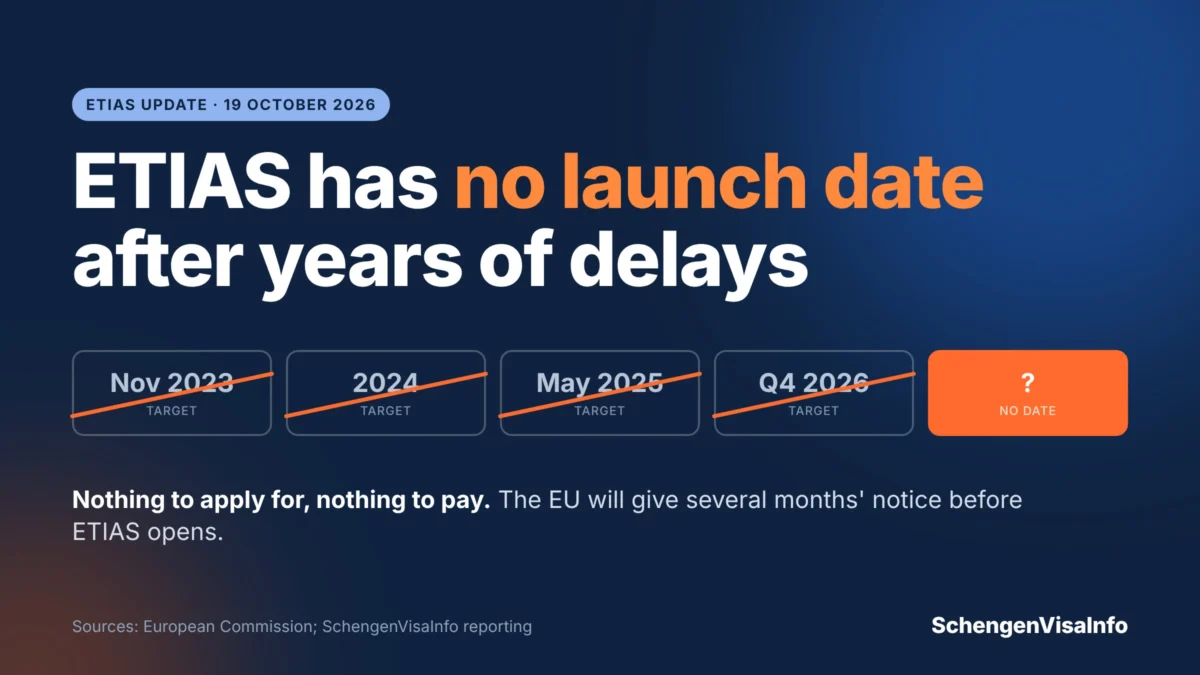
For years, the European Travel Information and Authorization System (ETIAS) has been presented as a critical component of the EU’s revamped border security architecture. It was designed to function as a visa-waiver program for citizens from more than 50 countries who currently enjoy visa-free access to the Schengen Area. However, as of mid-October 2026, the official digital portal managed by the European Commission offers no definitive timeline. Instead, the site merely states that the system is not yet in operation, that no applications are being processed, and that a formal announcement regarding the commencement of the program will be issued several months prior to the actual launch date.
This latest development marks a significant departure from the messaging provided by the European Commission earlier this year. As recently as the spring of 2025, officials were confidently pointing toward the final quarter of 2026 as the target launch window. That timeline was grounded in an interoperability roadmap endorsed by the Council of the European Union in March 2025, which envisioned a phased rollout, including a mandatory requirement for most travelers by roughly April 2027, following a six-month transition period. Now, that roadmap has been effectively discarded, and the silence from Brussels suggests that the logistical and technical hurdles facing the project remain substantial.
The Disappearing Timeline and Industry Uncertainty
The removal of the 2026 target in July of this year was handled with characteristic bureaucratic quietude, occurring without a formal press release or a high-level briefing. The adjustment came to light only when the explicit timeframe vanished from the Commission’s official web pages. Reports from the Financial Times subsequently indicated that eu-LISA, the EU agency tasked with the development and operation of the complex IT architecture required for the system, had concluded that a 2026 launch was no longer a feasible prospect. An anonymous EU official reportedly described the previous timeline as "illusory," signaling deep-seated concerns within the administrative apparatus regarding the system’s readiness.
This uncertainty has rippled outward to the travel industry. On October 13, 2026, ABTA, the influential UK travel trade association, confirmed to members at its annual convention that there is currently no official date for the implementation of ETIAS. For British, American, Canadian, Australian, and other visa-exempt travelers, the message from authorities remains consistent: there is nothing to apply for, and there is no fee to pay. Consequently, any third-party websites currently soliciting "ETIAS payments" or offering application services are fraudulent. Despite this, the confusion has persisted, with thousands of prospective travelers reaching out to travel news outlets seeking clarification on whether they should attempt to register early.
The European Commission did not provide an updated timetable or official comment in response to recent requests for clarification, underscoring the lack of a clear path forward.
The Complexity of Border Integration
The persistent delays surrounding ETIAS are inextricably linked to the broader, more complex roll-out of the Entry/Exit System (EES). The EES is a comprehensive biometric border registry designed to replace the traditional manual stamping of passports. Because ETIAS relies on the foundational infrastructure of the EES to function, the former cannot be deployed until the latter is fully stabilized across all participating member states.
The EES itself has faced a tumultuous journey, suffering from years of delays before a gradual rollout began in October 2025. By April 2026, the system was considered fully operational. However, the implementation was far from seamless. The transition period saw significant congestion at major international airports, with authorities forced to allow individual countries to pause the mandatory fingerprinting process during peak travel periods to prevent extreme wait times. This technical and operational strain appears to have forced a re-evaluation of the ETIAS timeline, as the EU prioritizes the stabilization of the EES before introducing another layer of digital border requirements. While the EU has not issued a formal explanation for the latest ETIAS delay, it is widely understood that the sheer scale of the technical integration and the potential for further border disruption have necessitated a more cautious, indefinite approach.
A History of Shifting Targets
The saga of ETIAS has been defined by a series of moving targets that have frustrated travelers and industry planners alike. Since the ETIAS Regulation was formally adopted on September 12, 2018, the program has missed a succession of intended launch dates. Originally, the system was expected to be operational around 2021. As that date passed, the timeline was pushed to 2022, then to May 2023, and subsequently to November 2023.
The pattern of delay continued throughout 2023 and 2024, with the target moving to May 2025 and then to the latter half of 2026. Each time a target was set, it was followed by a period of quiet transition as technical challenges mounted, eventually leading to another postponement. The current status—with no target at all—represents the most significant stall in the project’s history, reflecting the immense difficulty of harmonizing border control systems across 30 different countries.
What to Expect When the System Finally Launches
While the "when" of ETIAS remains a mystery, the "what" has been clearly defined by the existing regulations. When the system eventually goes live, it will apply to citizens of 59 visa-exempt countries and territories traveling to any of the 30 European countries that utilize the system, which includes the 29 Schengen member states plus Cyprus.
The operational parameters are straightforward: the authorization will cost €20, with exemptions for those under 18 or over 70. Once approved, the authorization will be valid for three years, or until the holder’s passport expires, whichever comes first. The application process is expected to be largely automated, with the majority of applicants receiving a decision within minutes of submission.
Crucially, travelers will have ample warning before the system becomes a prerequisite for entry. The ETIAS Regulation mandates a six-month transitional period once the launch date is set, during which the authorization will be optional. Furthermore, there is an additional grace period for travelers who are on their first trip following the end of that transition. Consequently, even if the European Commission were to announce a launch date tomorrow, it would still be months before a traveler could be legally denied entry for failing to possess an ETIAS.
For now, the best advice for travelers remains one of patience and caution. There is no urgency to engage with any platform regarding ETIAS, and the public is urged to ignore any entity attempting to collect fees for a service that does not yet exist. The European Commission’s official travel portal remains the only authoritative source for updates, and until a formal announcement is made, the current visa-free travel rules remain entirely unchanged. Travelers are encouraged to monitor official government channels and wait for a clear, confirmed implementation date before making any adjustments to their long-term travel plans.