When fans of Agatha Christie think of travel and classic murder mysteries, their minds naturally drift to the nimble, meticulous Hercule Poirot. This association has only been reinforced in recent years by cinematic revivals that took the globe-trotting detective from the plush, wood-paneled interiors of the Orient Express to a glamorous river steamer on the Nile, and eventually to a decaying Venetian palazzo.
By contrast, the world of Jane Marple—the elderly amateur detective whom Christie featured across a dozen novels and twenty short stories—has traditionally been considerably quainter. As an unassuming spinster settled deep in the English countryside, the vast majority of Miss Marple’s investigations have taken place right in her own backyard. However, a new novel authored by bestselling writer Lucy Foley is setting Poirot aside, blowing the dust off the mild-mannered sleuth, and whisking her away on an extravagant Swiss Alps adventure.
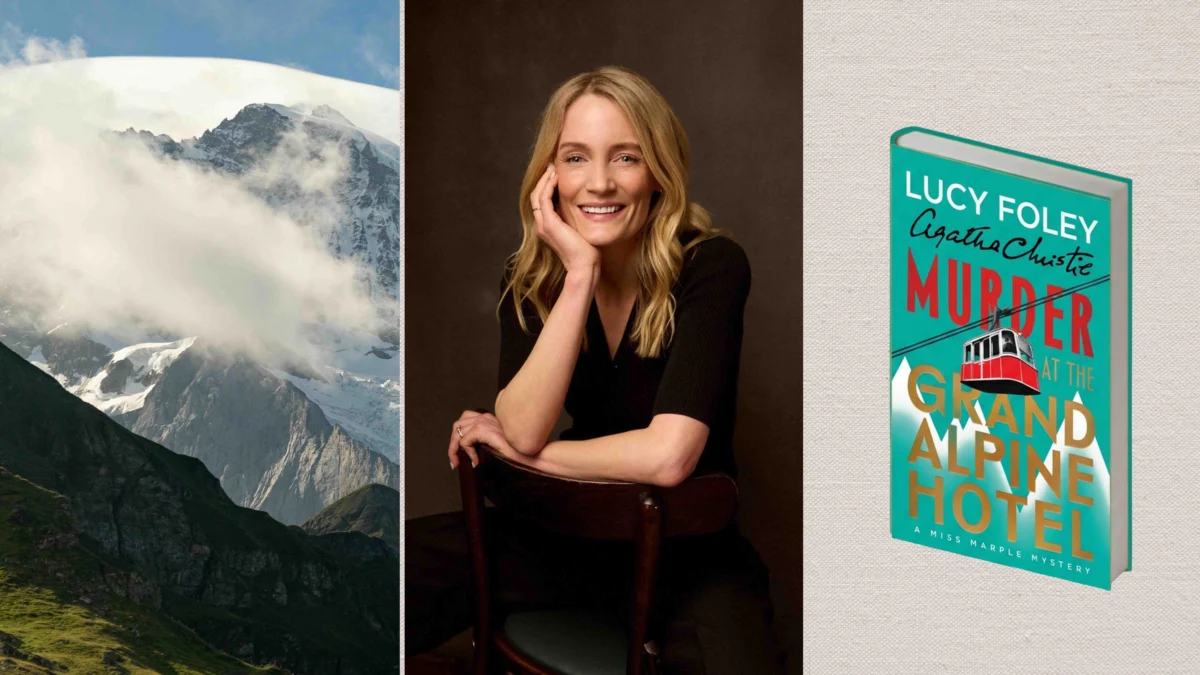
Marking the first new Miss Marple mystery in half a century, Murder at the Grand Alpine Hotel places the incorrigible Victorian observer into a milieu more commonly associated with the likes of James Bond or Sherlock Holmes. She finds herself thrust directly into the center of a sophisticated whodunnit deep within the bowels of the Grand Alpine Hotel, a luxurious Swiss ski chalet. Complete with hidden speakeasies, ice-skating waiters, and unforgiving mountainsides, the setting proves that Marple is far removed from the fictional English hamlet of St. Mary Mead, where many of her most famous cases previously played out.
Condé Nast Traveler recently spoke with Lucy Foley, author of the hit thriller The Guest List, who answered the Agatha Christie estate’s call to pen this historic installment. Foley discussed why she wanted to set the new book abroad, the layered history of the Alps, and what makes Miss Marple such a uniquely brilliant traveler.
Why transport Miss Marple from the quaint world of St. Mary Mead to the Swiss Alps?
The location is where this whole project came to life for me. I felt that as an Agatha Christie fan, I needed to write something that felt like it added something meaningful to the Miss Marple canon—something that was in conversation with the original books while also doing something entirely new.
The estate explicitly stated they wanted my unique take on a Miss Marple book rather than a paint-by-numbers imitation of Agatha Christie. Initially, I went back and forth on whether I should set it in St. Mary Mead. But then I had this idea of taking Miss Marple on another holiday, since she only gets to go on a single proper holiday in the original books. I always felt a bit sorry for her because of that limitation, and the project suddenly sparked to life from there.
I also wanted it to be in conversation with a very specific type of 1950s masculine action thriller. These were books frequently set in rugged places like mountain ranges, written by authors like Ian Fleming and Eric Ambler. I love their work because you get to travel directly on the page, which is something I always look for when I am reading. But I thought it was so amusing how clearly those books were written by men, for men.
What fun it would be to take that exact landscape and put two elderly ladies—say, Miss Marple and her close friend Mrs. Bantry—right at the center of it. That dynamic forms the real nexus of power in the book, and exploring how that alters the traditional narrative was a thrilling challenge.
Describe your research itinerary for this novel.
I traveled to several different spots across the Alps to get the atmosphere right. My main trip was to Chamonix in the French Alps, but from there, you are situated very close to both Italy and Switzerland, so I ended up driving to Zermatt, visiting St. Moritz, and traveling through the Mont Blanc tunnel to Le Corbier and various Italian resorts.
It was vital to get the texture of the environment completely right. I have been going to the mountains since I was a child because my parents are keen skiers and took us there from a young age. However, it is an entirely different experience when you are looking at those landscapes from the point of view of a researcher, trying to pin down all the historic details.
The way people thought about the Alps fundamentally changed at a specific point in history. It was really the Romantics who came along and reframed the mountains as a place of breathtaking beauty and wonder. Before that era, people had always thought of them as terrifying and quite ugly places populated by dragons and bad spirits, where only death and danger awaited. That historical dichotomy is still subtly built into the way we view and experience the mountains today.
What were your expectations of studying this region and its hospitality traditions? How did your travels meet or subvert those expectations?
Every time you go out into the mountains as a skier or a climber, you expose yourself to a level of danger that we do not encounter in normal daily life. I have done things like the Vallée Blanche, which is a demanding ski itinerary high above Chamonix. You are skiing down sections of the Mer de Glace Glacier, warned from the very beginning about steep drops. You have to strap on crampons, you are roped up to your companions, and you walk along a terrifying ridge. Once you are actually on the glacier itself, warnings are issued against lingering too long in any particular spot because of the persistent danger of hidden crevasses.
I also made so many wonderful discoveries during my research trips, such as the location of a hotel that sits high above Chamonix called the Refuge du Montenvers. I found it almost by happenstance, and I truly recommend people visit it. You take a little red train up the mountainside, and once the final train departs for the day, it is just you, the guests, and the immense peaks. That was wonderfully atmospheric and directly informed the setting of the hotel in my book.
Additionally, when traveling to St. Moritz and visiting storied establishments like Badrutt’s Palace Hotel and the Kulm Hotel, I came across incredible historical photographs of ice-skating waiters from decades past. I honestly did not realize that was a real historical phenomenon. These servers would wear full black tie, step out onto the ice with a tray laden with a champagne bucket and crystal champagne coupes, and perform intricate tricks while carrying drinks. Details like that are an absolute joy to weave directly into the narrative.
You transport readers to a 1950s chalet in Switzerland, which was a famously neutral European country. What was the importance of these hotels in their postwar hey-day? What role did they play in the changing social landscapes on the continent at the time?
In almost the very first scene of the book, you witness various groups of people packed together on a train on the way up the mountain, suddenly thrown into close proximity once again. You have Italians, the French, the British, Americans, and even some Germans, and people are visibly bristling at the tension. It was only five years after the conclusion of the Second World War, so many individuals found it hard to believe they were sitting cheek by jowl with their former enemies.
In Britain, rationing was still strictly enforced throughout the 1950s. People were still visibly underweight, and citizens in other parts of Europe were genuinely feeling the pinch of postwar austerity. I found it fascinating to highlight those differences during that train ride to the hotel. Diana Glass, who serves as Dolly Bantry’s assistant, remarks that she can easily identify the nationalities: the Italians have the finest luggage, the French wear the most luxurious furs, and the British all look a bit hungry and gray.
I was also deeply interested in the geography of the region. In this specific part of the Swiss Alps, near the borders of France and Italy, mountain passes were historically more porous than other frontiers because they are much harder to man and defend. What would that reality have looked like during the Second World War, and how would it inform the immediate history of a grand hotel? Who might have been milling around the area during the conflict? Naturally, that feeds directly into the hidden backstories of several characters. Without spoiling too much, some of them have returned to the region more recently than they let on, having quietly rewritten their own wartime histories to serve their personal agendas.
Agatha Christie herself once gave away her formula for what makes a good mystery: "The whole point of a good detective story was that it must be somebody obvious but at the same time, for some reason, you would then find that it was not obvious, that he could not possibly have done it. Though really, of course, he had done it." For you, what makes a hotel such a great keeper of that suspense?
There is a very specific geography inherent to a hotel, and you frequently find hidden architectural spaces that are only known to seasoned or favored guests. In Murder at the Grand Alpine Hotel, I had a wonderful time incorporating elements like a secret bar, similar to the one that exists at the Kulm Hotel.
A hotel also provides a profound sense of anonymity. People can check in and adopt a persona that they could never sustain back at home. I think Agatha Christie utilized that concept brilliantly in At Bertram’s Hotel, playing with the idea that a hotel is simultaneously a strangely democratizing space and a deeply anonymous one where individuals might not be who they appear to be.
What makes Miss Marple such a great traveler?
Her greatest asset is her extraordinary ability to observe. She is such a profound reader of human character, and that is a skill she can successfully apply wherever she happens to be. It is amusing how she is always referencing things back to her everyday experiences in St. Mary Mead, because she views that village as a wonderful microcosm of everything humanity is capable of being. You see that same trait even in A Caribbean Mystery, which is the furthest she travels in the original novels.
There is always an observation from her lived experience that she can apply to a new environment. She accepts people entirely as they are, regardless of their background or where she encounters them, and she consistently perceives the core truth of their personalities. I think that is a fundamental trait distinguishing her from Poirot. We often see Poirot’s judgment clouded by some pretty young person whom he cannot possibly imagine doing anything unpleasant, only for them to turn out to be pure malice—whereas Miss Marple would have seen through them from the very beginning.
She is also a remarkably enigmatic figure in her own way. Do we ever truly witness the absolute truth of Miss Marple? At times, we catch flashes of genuine, fierce anger; in A Pocket Full of Rye, she is primarily motivated by anger to solve the murder. In Nemesis, there is a powerful scene where she assumes the literal mantle of nemesis, functioning in a potent, shape-shifting manner. She can adapt to whatever role another character needs her to fill at a given moment, bearing a slight resemblance to the Gray Man archetype from spy fiction, yet she remains entirely and uniquely herself throughout.
If you had the opportunity to do so, where would you want to send Miss Marple next?
I am not sure if I want to show my hand too much here, as this project is currently very much a standalone endeavor. However, I can drop a small Christie Easter egg without naming the exact location, allowing readers to do a bit of detective work of their own: Miss Marple has not always lived in St. Mary Mead. We learn that in her youth, she lived in a different country for a period of time, so I suspect I would take her right back there.