“Now you know what it’s like to be in the eye of a storm,” said our hiking guide, Audun Rasmussen, flashing a wide grin as the wind howled around us.
I tried to nod, but the gale whipped my head into a sudden wobble. We were nearly 2,000 feet up a steep, multi-edged mountain face, simultaneously getting pelted by a relentless, sideways rain. If sweeping views over picturesque towns and calm freshwater lakes below are what is typically promised in this part of Northern Norway, today there would be none of that. Instead, thick fog clung tightly to every nook and crevice of the ancient glacial hulks surrounding us.
There was a profound sense of achievement, certainly. The persistent rain had turned much of our hiking trail into sinking mud and slick, gripless stone. We had been forced to use our hands to push past dwarf birch branches and had skidded helplessly on wet moss. And we still had to make our treacherous way back down. But for now, we were enveloped in the clouds, hiding under rocky overhangs and finding momentary reprieve in reindeer-meat sandwiches, dry fish bites, and chocolate-covered wafers called Kvikk Lunsj, which translates simply to “a quick lunch.”
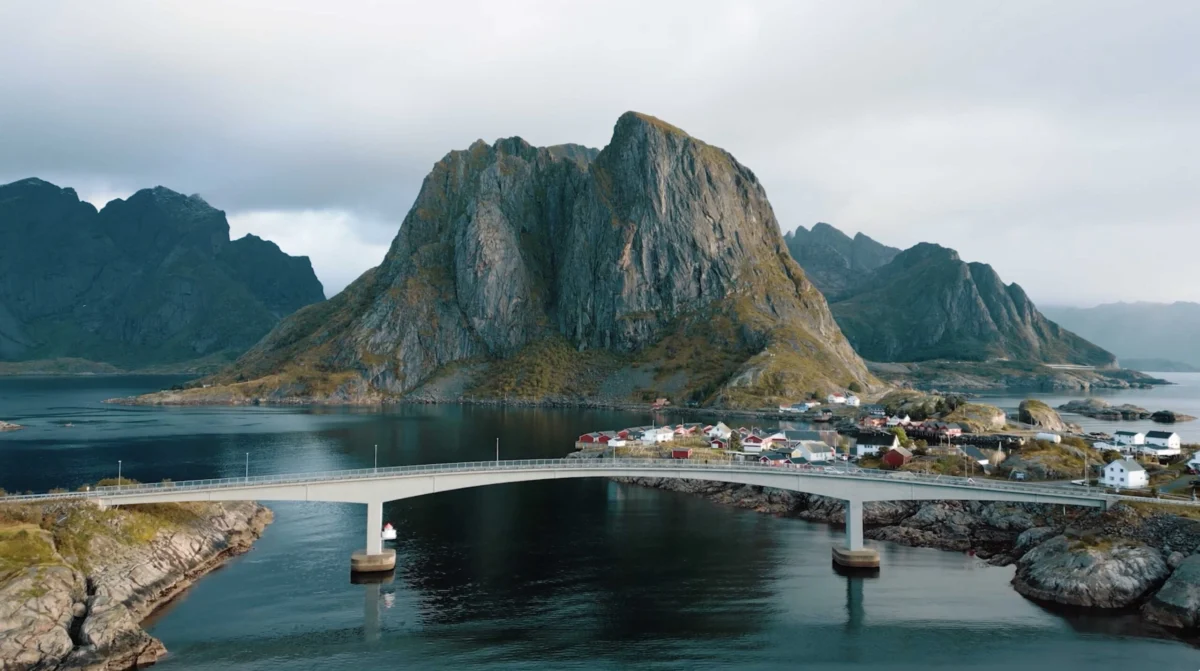
It is ascents like these, scaling rock foundations that vastly predate the Jurassic period, that draw close to a million visitors each year to the Lofoten Islands. Located 68 degrees north of the Arctic Circle and reached via two flights from Oslo, this tiny Norwegian archipelago features a distinctive and dramatic landscape where spiky, vertical mountains rise straight out of the Norwegian Sea, flanked by pristine sandy beaches fringed by deep fjords. In the summer months, buoyed by endless daylight, adventurers arrive from the Norwegian mainland to camp, climb, and swim in the chilly waters.

However, summer was well past its twilight when I arrived in late September, and I had come to discover an entirely different side of Lofoten: one found not on its dizzying peaks, but on its plates.
From Cod Factory to Culinary Haven
In a wind-whipped corner of Sørvågen, a small village situated in the southwestern reaches of the archipelago, a cluster of mustard-colored cabins on stilts juts dramatically out into the sea. Once home to a bustling cod processing factory, these historic buildings have been thoughtfully transformed into Holmen Lofoten, a unique culinary destination and hotel that has welcomed food lovers, chefs, and global adventurers since 2007. The traditional fishing cabins, known locally as rorbuer, are distinguished by their corrugated iron roofs, some of which are traditionally topped with thick, insulating grass.
Elevated wooden walkways connect the buildings to one another and to expansive wooden decks facing the open sea. Inside the guest rooms, large picture windows frame the wild ocean and craggy shoreline. With its simple local furnishings and hand-hewn charm, everything about the property feels elemental and deeply connected to the marine history of the site.
During my four-day stay, Holmen played host to Kitchen on the Edge of the World, an extraordinary culinary event launched in 2018 that welcomes acclaimed international chefs into its kitchen four times a year, bringing guests together around communal tables and out into the surrounding wilderness. This milestone 30th edition of the event was helmed by Matt Orlando, a California-born, Copenhagen-based chef who has previously worked at some of the world’s most influential kitchens, including The Fat Duck in London and Per Se in New York. For our part, we would feast and drink to our hearts’ content, with the very landscape that nurtures every dish spread out just beyond the windows.

Ingunn Rasmussen, the warm and chatty matriarch behind Kitchen on the Edge—and hiking guide Audun’s sister—took over the property in October 2001 and now runs it alongside her son, Håvar Holmen.
“I wanted to build a space that felt like home, where we could all log off and reconnect with our natural roots,” she said when she picked me up from the airport. As a local fisherman’s daughter, she grew up around this exact site; in fact, one of the historic cabins still bears her sister’s childhood scribbles on the wooden wall. Following a period spent living abroad, Ingunn returned determined to breathe new life into this remote corner of Lofoten. What followed was a meticulous restoration focused on preserving the original structures and historical details, eventually complemented by the addition of a few new buildings constructed in the same architectural vernacular to accommodate larger suites.
Tastes of the Autumnal Palette
On the first night of the multi-day gathering, we gathered in the cozy living room situated directly above the kitchen. Like all of Holmen’s shared spaces, it is defined by rustic interiors, exposed timber beams, and raw, sculptural elements—foraged flora, taxidermy, and found objects—that directly echo the weathered landscape outside. That evening’s dinner was executed by Holmen’s own resident chefs, a young and talented international assemblage hailing from as far away as Sicily and Piauí in northeastern Brazil.
Servers circulated with trays of delicate shrimp croustades and cocktails that looked deceptively like Negronis but told a much more localized story: the vermouth had been infused with foraged blackcurrant leaves, while the Campari was steeped with dried local berries and yarrow flowers. Each sip seemed to capture the earthy autumnal palette I had seen blanketing the hillside during our drive in. The nonalcoholic beverage options were just as heady, featuring an elderflower tonic paired with a syrup made from freshly picked wild hops found nearby.

“Holmen was created because we want to show our guests the Lofoten Islands,” Ingunn said. “And food is a critical part of understanding it.”
I wandered over to Mia Hjorth Hansen, co-owner of Gedulgt, a cocktail bar in Aarhus, Denmark, and the resident mixologist for Kitchen on the Edge. Shelves surrounding her workstation held glass jars filled with foraged and dried ingredients—cornflower, dandelion, and fireweed—which she was actively transforming into complex elixirs. While visiting guest chefs rarely return for repeat events, Hansen is a notable exception, marking her twelfth time participating in Kitchen on the Edge.
Still, a clear through-line unites all the visiting culinary talents. Whether it is Ana Roš, the renowned Slovenian chef behind the three-Michelin-starred Hiša Franko, or Simon Rogan, the prominent UK pioneer of the farm-to-table movement, each visiting chef shares an unwavering commitment to land stewardship.
“We take time picking them,” Ingunn noted, explaining the selection process for visiting talent, “because we want chefs who will be considerate about the people and wildlife that make this our home.”

Foraging the Subarctic Wilderness
The opening night of the event is intentionally designed to serve as an icebreaker, and Ingunn had warned us we would be surprised by how quickly we grew comfortable sharing close quarters over the course of four days. Our group was a motley crew of travelers, including a geologist from Brunei, a committed adventurer from Dubai, and a Melbourne retiree who routinely travels across the globe for intimate food events like this one. Our conversations naturally followed us outside for dessert, out onto a wooden deck where we savored ice cream made with blackcurrant leaves and lovage, topped with rich mascarpone made from local Lofoten cream, and finished with a meringue charred over binchotan, a traditional Japanese white charcoal.
A tracking app on our phones suggested the Northern Lights were tantalizingly close, and the Holmen team kept a watchful eye on the clearing skies. It was merely a taste of what was to come: an intimate experience shaped entirely by live-fire cooking and a fearless embrace of the raw Arctic elements.
The following morning, encouraged by Ingunn’s open invitation to explore every corner of the property, I wandered into the kitchen to watch Orlando and his sous chef, Tom Siebeler, prepare for their first official dinner service.
“Anything that comes out of that wood-fired oven is going to taste amazing,” Orlando told me as he worked his way through a pile of reindeer ribs sourced from a sustainable farm run by Indigenous Sámi herders just north of Lofoten. Originally expecting standard chops, he was actively improvising garnishes to complement the rich ribs.

Reindeer is just one of many ingredients Holmen takes great care to source locally, alongside regional cheeses, Lofotlam (a protected, geographically indicated local lamb), and hardy vegetables.
“For us, knowing where things come from matters, even with the objects we use,” Ingunn said. The exquisite ceramic tableware we dined on throughout the event, for instance, was crafted by local ceramicist Gunvor Tangrand, whose organic forms pay homage to the surrounding terrain and whose textured surfaces cleverly incorporate recycled local fishing yarn.
Orlando had arrived in Lofoten a few days prior carrying a case filled with his favorite foundational culinary building blocks—barley, Danish yellow peas, and several varieties of artisanal miso—but he was clearly most excited to work with whatever he could unearth in the immediate surroundings. He invited me to step outside to forage for his evening dinner menu, and we returned shortly with fresh chickweed, corn shoots, and wild sheep sorrel.
“I love cooking in remote places,” he said. “Thinking on the fly and exploring the potential in things you’ve never worked with before is where the coolest ideas come from.”

A Zero-Waste Philosophy in Action
Orlando is no stranger to visionary culinary concepts. Years ago, he opened Amass, a circular restaurant in Copenhagen’s industrial Refshaleøen neighborhood, where friendly service and an approachable, low-waste tasting menu were paired with a harborside produce garden that diners were encouraged to wander through. While Amass has since closed, Orlando opened Esse in a restored Nordhavn warehouse, earning its first Michelin star just months later. Signature items, such as his famous fermented potato bread, made the move with him, alongside his uncompromising commitment to environmental responsibility. At Holmen, that philosophy proved to be a natural fit.
Later that night, as we gathered around communal tables adorned with wild flowers and flickering candlelight, the room erupted in delight when the warm potato bread arrived alongside rich allium butter, and again when the kitchen served up fishbone noodles—a masterful creation achieved by pressure-cooking fish bones and puréeing them until completely smooth. The naturally collagen-rich mixture gives the noodles their uniquely slippery texture, which Orlando complemented with smoked chili, sunflower-seed miso, and fermented chili cream.
Served family-style, the meal was tactile and fun, with formal utensils largely set aside so we could savor the main course of reindeer directly with our hands. As a pescatarian, I happily dug into an alternative dish: hedgehog mushrooms grilled over an open flame with a chili-strawberry barbecue sauce, served alongside a vibrant local Lofoten chimichurri. Outside, the bright harvest moon kept quiet watch over the fjord.
The Lifeline of Arctic Cod and Modern Agriculture
The weather in the North changes with startling swiftness—quiet and calm one minute, then wild and dramatic the next.

“Four seasons in an hour,” Holmen joked.
It is this unique confluence of harsh climatic conditions that makes Lofoten such a surprisingly productive landscape: the interaction between the warmer Gulf Stream and the cold Arctic waters sustains an abundance of marine life; the endless hours of summer sunlight send terrestrial plants into hyperdrive; and the mineral-rich sea spray nourishes the pastures where local sheep graze.
“This land and sea have nourished us for generations,” said Ingunn, who frequently leads guests on coastal foraging walks, returning with fireweed flowers for immune-boosting teas, wild cloudberries for sweet preserves, or fresh lovage for vibrant, savory butters.
However, to truly understand this landscape is to comprehend its enduring connection to one particular food source: skrei, or migratory Arctic cod. Here, traditional tepee-style wooden drying racks known as hjeller are as much a visual fixture of the landscape as Lofoten’s jagged mountains; their distinctive A-frame timber structures have dotted the coastal terrain for more than a thousand years.

The racks were largely empty during my autumn visit, but come January, they will be densely stacked with skrei caught at the end of their epic annual migration from the Barents Sea down to Lofoten’s milder coastal waters to spawn. Transformed into tørrfisk—wind-dried stockfish—this seasonal bounty has sustained the local maritime economy for centuries. Yet, like many other coastal communities shaped by the economics of Atlantic cod, Lofoten has faced ecosystem pressures over recent decades, ranging from shifting fish migration patterns to the pressures of industrial offshore fishing fleets.
Perhaps it is little surprise, then, that a more diversified agricultural and artisanal movement is taking root across the islands. One rainy afternoon, I departed from the cozy confines of Holmen and drove an hour north to the fishing village of Napp, home to the Lofoten Seaweed Company, whose products supply both Holmen’s kitchens and our guest bathroom shelves.
Co-founded by Angelita Eriksen and Tamara Singer, this entirely women-led team routinely dons wetsuits to hand-harvest seven varieties of local seaweed, including sugar kelp and nori, directly from the powerful tidal currents of local straits like Nappstraumen, transforming them into prized culinary seasonings and natural cosmetics. Singer showed us around their processing facility, housed inside a traditional rorbu where Eriksen once cut out cod tongues as a child—a common way for youngsters in the region to earn pocket money, she explained—and where they now carefully sort, store, and age seaweed destined for top-tier Nordic kitchens like Noma and Geranium in Copenhagen.
Navigating the Tensions of Modern Tourism
They are not alone in this artisanal push. Across the islands, independent cheesemakers and farmers cultivating root vegetables and edible flowers are actively enriching the region’s agricultural footprint. Back at Holmen, I spoke with local resident Bjørg-Elin Kjærn, who specializes in food and agriculture systems at Love Food, an organization dedicated to connecting small-scale regional producers with local restaurants.

“Lamb, stockfish, and seaweed are all remarkably sustainable ways of producing food,” Kjærn noted. “But conservation only works when the people living on the land and by the sea can make a good living. When a restaurant chooses these products, it helps keep that whole system alive.”
Kjærn also works to steer incoming tourism toward local food culture and sustainable agriculture, rather than simply encouraging visitors to pitch tents haphazardly and climb mountains without preparation. The growing toll of ill-prepared mountain tourism remains a sensitive sore point among local residents. Holmen’s own mountaineering guide, Audun, often prefers not to share the exact names or locations of his favorite climbing ascents, fearing that overexposure on social media will draw the wrong kind of attention, particularly from underprepared hikers who underestimate both the technical difficulty of the routes and the sudden whims of Arctic weather. In response to these pressures, Lofoten instituted strict regulations a few years ago banning random wild camping and restricting campers to designated grounds.
It is clear that mass tourism has come knocking on Lofoten’s door. Visitor growth in Northern Norway has outpaced the rest of the country, bringing with it a familiar modern tension: how to warmly welcome travelers while fiercely protecting the delicate environment that makes the place worth visiting in the first place.
“Our hope is that people come to Lofoten for the right reasons,” Ingunn told me. “Ultimately, that will be what helps us protect the islands and our way of life.”

Food, increasingly serving as a primary anchor for how people choose to travel, offers a meaningful bridge across that gap, inviting visitors in while helping them deeply understand the ecosystem they have come to experience.
“Here, you can’t separate food production and landscape,” Kjærn added. “Much of what visitors come to see, whether they consciously know it or not, is ultimately shaped by food.”
In this way, Kitchen on the Edge hopes to sound a call for travelers to rethink why and how they visit fragile destinations like Lofoten. Hospitality that takes guests beyond the plate and directly into the fields and waters is not merely a novel perk—it is an essential way of life.
A Rhythm Rooted in the Land
On one particular morning when the weather cleared just enough, we piled into inflatable rigid-hulled boats that cut swiftly through choppy waters over to a deserted, uninhabited island. Once a thriving fishing village, the settlement was abandoned when motorized boats became commonplace in the mid-20th century, rendering it unnecessary for fishing communities to live directly adjacent to the spawning grounds. Today, nature has completely reclaimed this idyllic spot—where Ingunn spent her childhood summer days picking wild berries and swimming—blanketing the terrain in rushing waterfalls and thick carpets of spongy reindeer moss.

While other members of our group traced the rugged shoreline on foot, I sat quietly by the old wooden jetty and took it all in: the towering mountains disappearing upward into low-hanging clouds, a pair of white-tailed eagles circling effortlessly overhead, and the miniature subarctic flora carpeting the ground beneath my boots. There is a psychological shift that occurs when your mind is forced to constantly zoom out to take in a vast, cinematic landscape, and then instantly narrow its focus down to the smallest botanical details. I later learned there is a scientific term for it: attentional elasticity, a framework that helps anchor individuals firmly in the present moment. It is likely why I felt such a profound sense of stillness, despite the lingering fog of jet lag and the constant motion of the activities swirling around me.
Later, the hotel crew built an open campfire around which we ate steaming fish soup, taking turns winding dough around birch sticks to bake pinnebrød over the open flames. A flask of aquavit—affectionately referred to around these parts as holy water—made a welcome appearance, passed from hand to hand.
At Holmen, daily encounters with nature quickly became woven into our regular rhythm. We foraged not just for ingredients, but for artistic materials as well, gathering moss, mushrooms, and berry-heavy branches to create wild, organic tablescapes alongside Becky Hindley, a visiting British botanical artist. In a drafty woodworking cabin where the sunlight poked through the timber walls with optimistic warmth, we spent hours with Lee John Phillips, a woodcarver from Wales, patiently fashioning utility spoons out of local birch. It is a specific kind of luxury, one firmly rooted in the ancient knowledge of how to build a sustainable life directly from what the land provides.
As in any welcoming home, the kitchen remained the beating heart of the house, drawing us back repeatedly throughout the day: to watch chefs pry open fresh Icelandic queen scallops and slice basketfuls of wild chanterelles and hedgehog mushrooms. Orlando was always within easy reach, sharing impromptu recipes and sparking lively conversations about global food systems. Unlike many modern culinary festivals featuring rigid barriers, there was no peeking behind a curtain here, because no curtain existed.

“This is my ultimate dream for a restaurant,” Orlando said on the night of his final multi-course presentation, as we savored grilled pollock seasoned with chard and shishito butter while sipping a remarkable oat milk drink flavored with green cardamom, rose, and spiced apple. “To be able to have diners weave in and out and casually chat as I cook.”
As it happened, the clear, bright blue skies we had initially hoped for never quite materialized during my four days on the islands. But the astonishing dishes served beside a crackling wood-fired oven, the effortless camaraderie shared around the communal dinner table, and the lingering, ever-present possibility of spotting the Northern Lights left me far more awake and attuned to the natural world than I had felt in months.