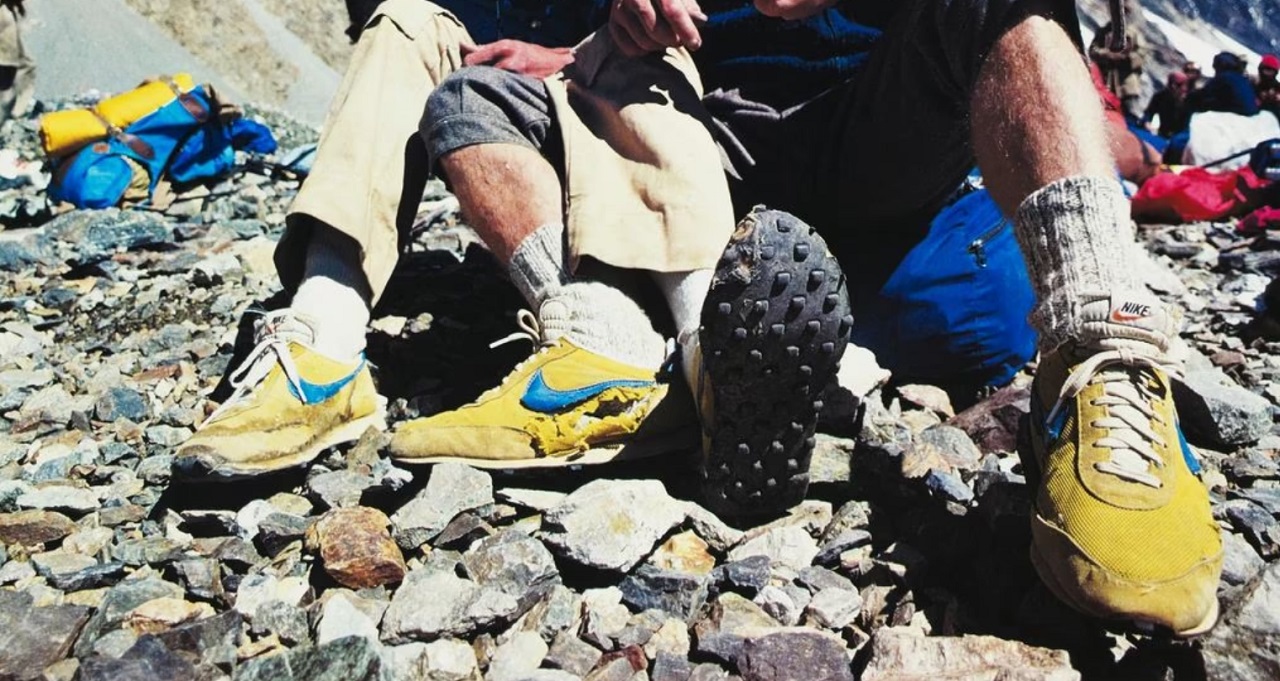
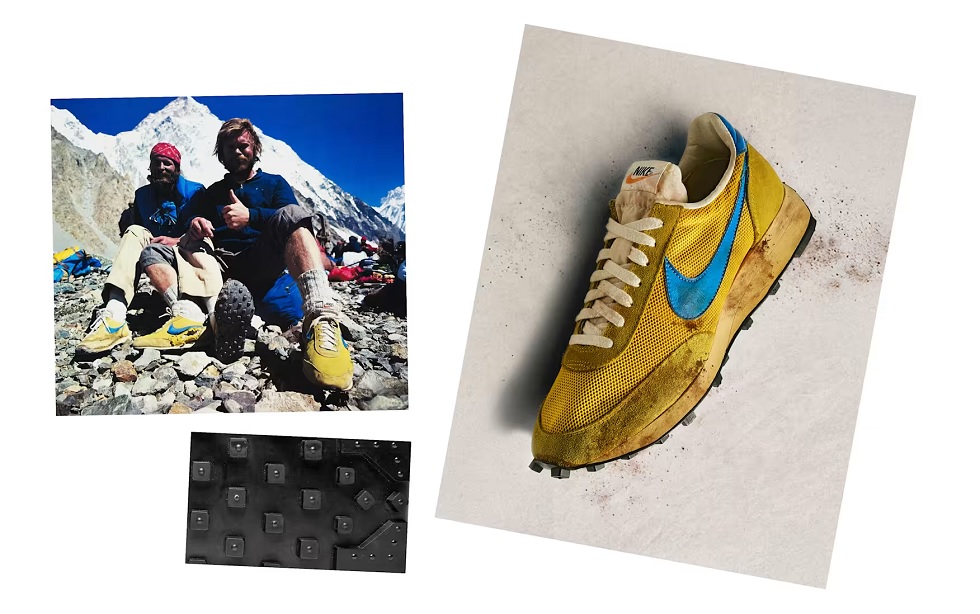
There is a photograph that explains Nike ACG better than any lookbook ever has. Two men sit at the foot of K2, faces lean after 68 days on the mountain, snow-streaked ridgelines rising behind them. On their feet are yellow Nike running shoes that are torn in bits. One of the men has a thumb raised to the camera. The shoes were a last-minute gift for the long walk in, coming from a young company that wasn’t even in the outdoor business yet.
That was 1978, and those shoes accidentally laid the groundwork for a cult brand—one that evolved, inspired, and, for a long stretch, became something of a ghost. Now, the label is trying to earn its way back into the outdoors. Which, as it turns out, is considerably harder than it sounds.
A Gift for the Walk In
By 1978, K2 had been successfully climbed exactly twice. An Italian expedition reached the top in 1954, and a vast Japanese team followed in 1977. Americans had tried four times since 1938 and failed each time, earning the mountain the uncharitable nickname of the American mountain.
The 1978 attempt was led by Jim Whittaker, the first American to summit Everest, who was running REI at the time. Having turned back at 22,000 feet on K2 in 1975, the failure had festered within him. This time, he assembled a team of fourteen—mostly Seattle climbers, including his wife, photographer Dianne Roberts—and funded the expedition by cold-calling brands. One of the companies that agreed to help was a young, rapidly growing Oregon firm that was far from flush: Nike.
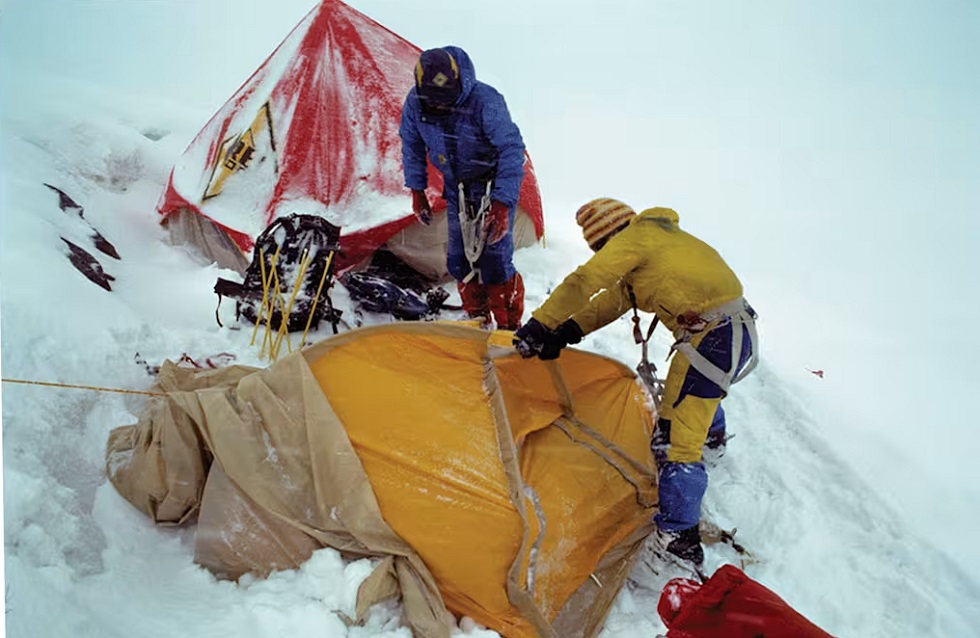
The mountain lived up to its brutal reputation, unleashing nine storms in quick succession. Camps had to be built repeatedly amid internal personality clashes. Then, in early September, a brief weather window opened. On September 6, Louis Reichardt and Jim Wickwire reached the summit. Reichardt’s oxygen hose had punctured, forcing him to make the final push without supplemental oxygen—a first for K2. Wickwire spent nearly twenty minutes changing his camera film in the freezing cold, and by the time he began his descent, twilight was closing in without a headlamp. He was forced to endure one of the highest bivouacs ever recorded.
The next morning, Rick Ridgeway and John Roskelley set off on a dual summit and rescue mission. Finding Wickwire on his way down, they abandoned the direct finish due to avalanche danger, traversed to the standard route, and reached the top. Four Americans had summited in two days. Everyone returned home, though Wickwire had to be evacuated by a Pakistani military helicopter suffering from pneumonia, pleurisy, and blood clots.
Before any of that drama unfolded, there was a punishing 110-mile walk to base camp, much of it off-trail. Nike had quietly supplied lightweight running shoes for the approach: yellow Long Distance Vectors, road shoes evolved from the LD-1000 and designed by Bill Bowerman alongside Eugene orthopedist Dennis Vixie. Inside Nike, they were known as the Long Distance Vixie. Ridgeway and Roskelley wore them instead of the stiff European leather boots favored by climbers of that era.
The shoes worked brilliantly. Softer, more flexible, and vastly more breathable than traditional trekking boots, Ridgeway noted they were ideal for the boulder-hopping approach. However, they were never built for high alpine work; by base camp they were completely wrecked, and by the walk out, Ridgeway and Roskelley were holding them together with tape and glue.
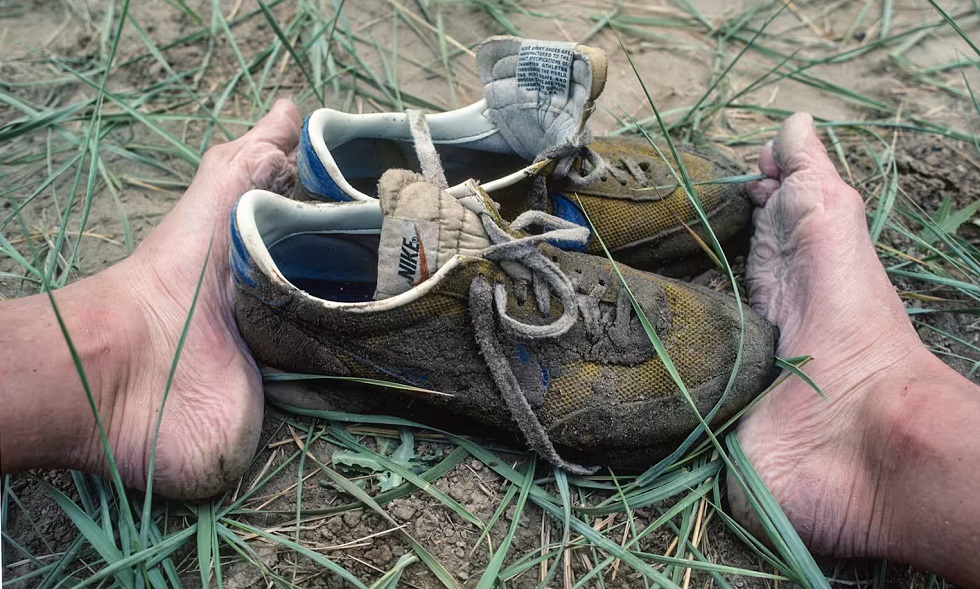
The expedition had made another footwear bet as well, purchasing one hundred pairs of Vibram-soled shoes for their porters, who had walked in barefoot during the 1975 attempt. The 1978 porters reached base camp in thirteen and a half days—nearly half the time of the earlier trip. On the walk out, Ridgeway and Roskelley discussed how the LDV could be transformed into a proper trekking shoe, mailing their ruined pairs back to Nike upon their return with a brief list of demands: a tougher sole, a rugged upper, and a lightweight build. Nobody in Beaverton knew it yet, but they had just written the first product brief.
Light Is Right
Nike took the feedback seriously, turning the wrecked LDVs into a profound philosophical argument: lightweight footwear could survive in places where only heavy boots were supposed to tread. By the early 1980s, this mantra produced three distinct footwear models: the Lava Dome, the Approach, and the Magma.
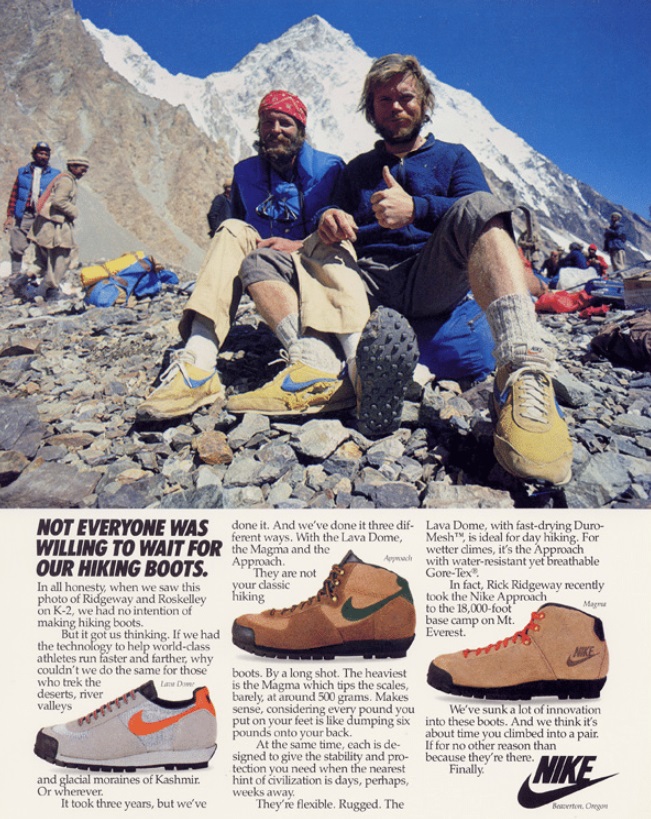
The Approach was Nike’s first shoe featuring a GORE-TEX lining, manufactured in Saco, Maine, with a waffle outsole and a leather-and-Cordura upper. The Lava Dome, designed by Trip Allen and Monte Mayko, became one of the company’s first lightweight hiking shoes. Ridgeway continued testing prototypes, and when Nike ran its first outdoor print ad, it featured Dianne Roberts’ photograph of him and Roskelley at base camp in their destroyed LDVs.
Meanwhile, internal shifts continued. In 1984, a young designer named Mark Parker drew the Escape, marking Nike’s formal entry into trail running. Three decades later, as CEO, Parker would hand the ACG reins to a Berlin techwear designer.
All Conditions
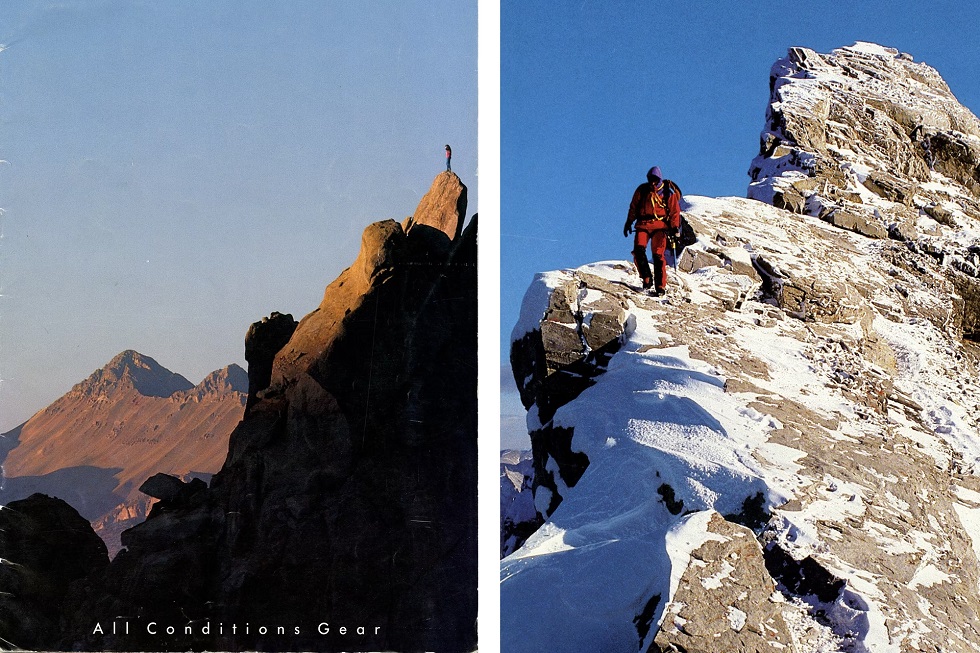
By the mid-1980s, Nike possessed a drawer full of outdoor experiments without a unifying name. Hiking shoes, trail runners, and apparel pieces sat in separate corners of the company. In 1987, a small team led by Tom Clarke and Kirk Richardson—a lifelong mountaineer—set out to consolidate them. They recognized a clear market gap: while European legacy brands built heavy, rigid gear for specialists, Nike saw room for athletic gear designed for movement in any weather.
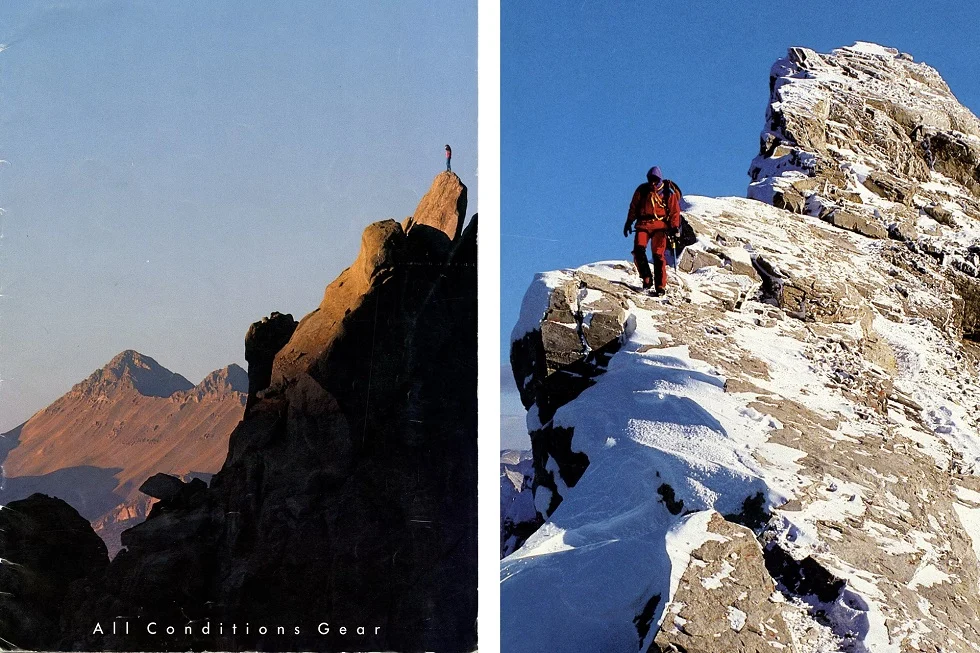
They established four core principles: high performance, durability, versatility, and functional excellence, bringing footwear and apparel under one roof. The name itself was discovered by accident, borrowed from a small line of year-round apparel already labeled All Conditions Gear by Nike Running. In 1989, ACG became official. For its debut catalog, the team traveled to Moab, shooting climbers on Castleton Tower with an adventurous, self-aware tone encapsulated by the slogan: "All conditions gear, and all conditions means all conditions."
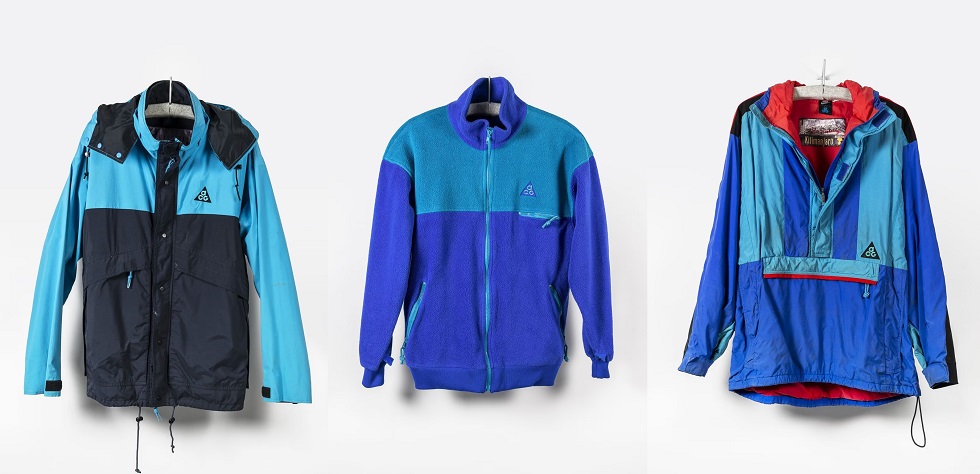
The first collection landed that autumn, anchored by the Air Wildwood and the Lava High, alongside GORE-TEX and fleece outerwear named after real mountains and expeditions, such as the Huascarán jacket and the Kilimanjaro anorak signed by John Roskelley.
Mowabb and the Golden Years
The 1990s marked ACG’s creative peak, defined by a shoe named after a desert town. In 1991, Tinker Hatfield designed the Air Mowabb, named after Moab, Utah. Fusing the Air Huarache with the Wildwood, it featured a neoprene bootie, Native American moccasin nods, and a speckled midsole that would later influence numerous other Nike designs.
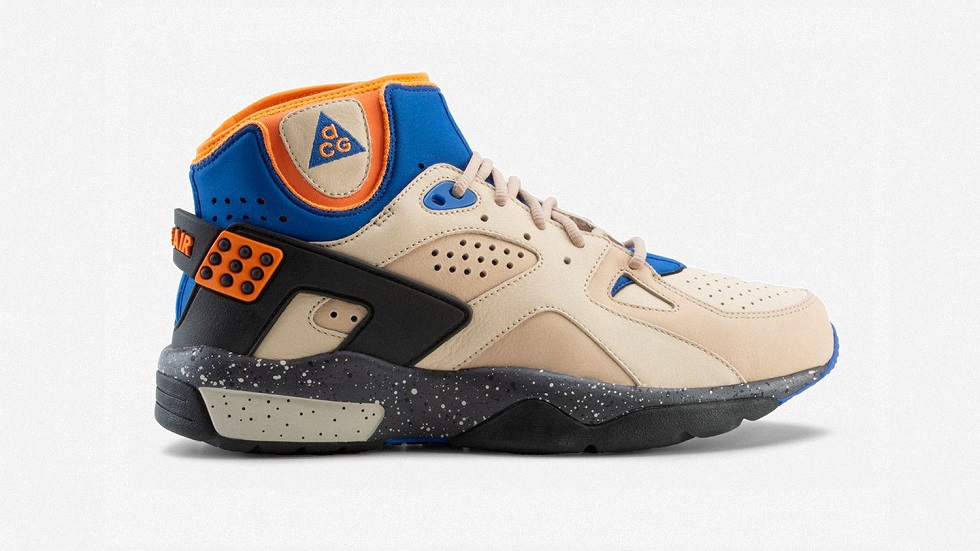
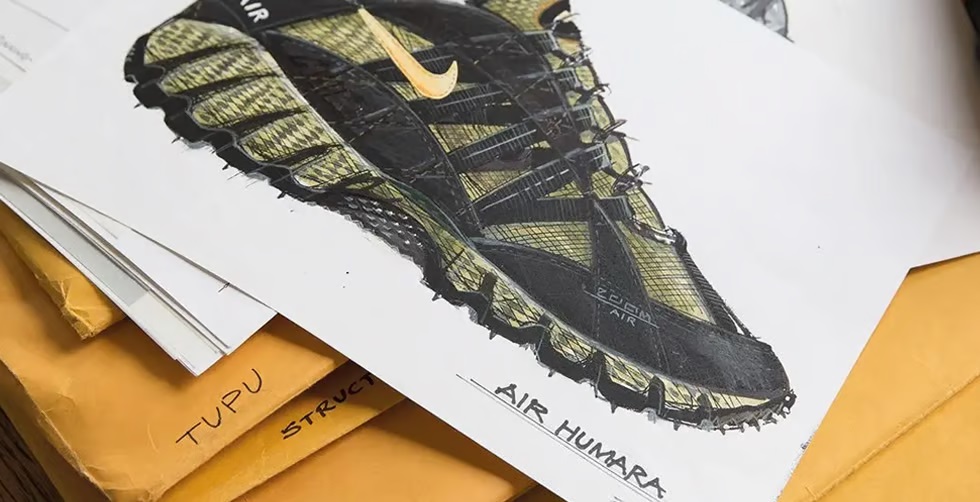
The hits persisted: the 1993 Air Deschutz sandal, the 1994 Air Moc slipper-boot hybrid, the rugged Air Mada, and Peter Fogg’s engineering-driven Air Humara. ACG became a playground for inventive designers, producing gear built for the mountains that looked equally striking on city streets. It was an early preview of an industry-wide question: what happens to an outdoor brand when the city claims it? By 2017, the term "gorpcore" was coined to describe functional outdoor wear worn as streetwear, a space ACG had inhabited for nearly three decades.
The Quiet Years and Errolson Hugh
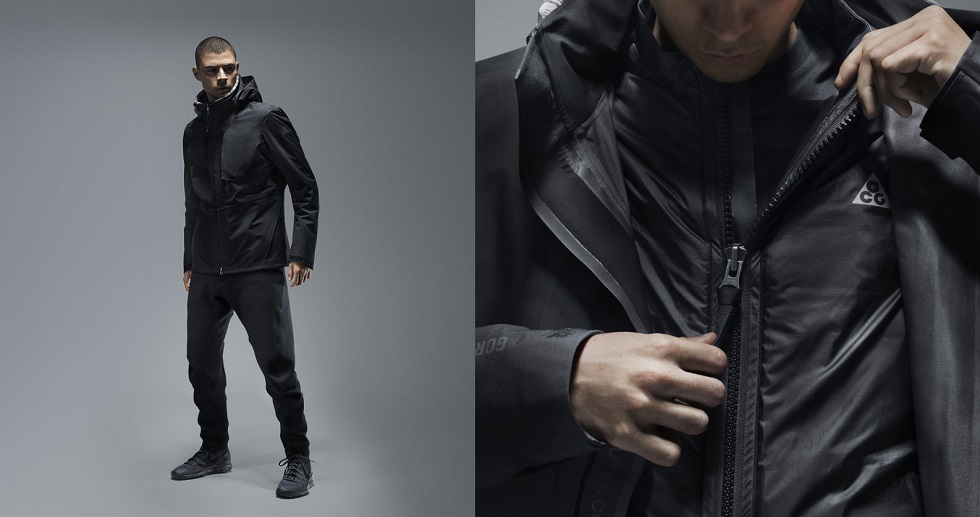
By 2008, ACG had largely faded, reduced to a handful of lingering products devoid of their original spirit. Then, in December 2014, Nike CEO Mark Parker tapped Errolson Hugh, co-founder of Berlin techwear label Acronym, to rebuild the line as NikeLab ACG under the banner of "sport utility for the city."
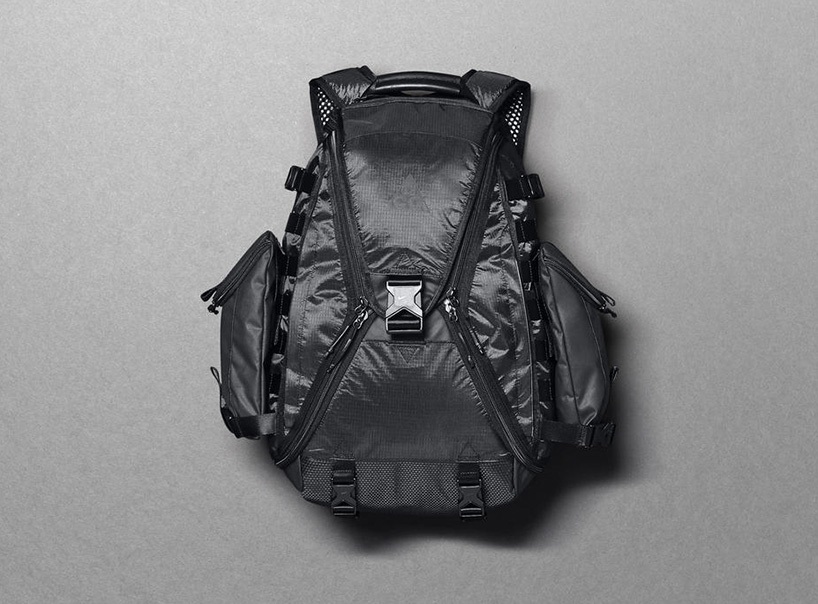
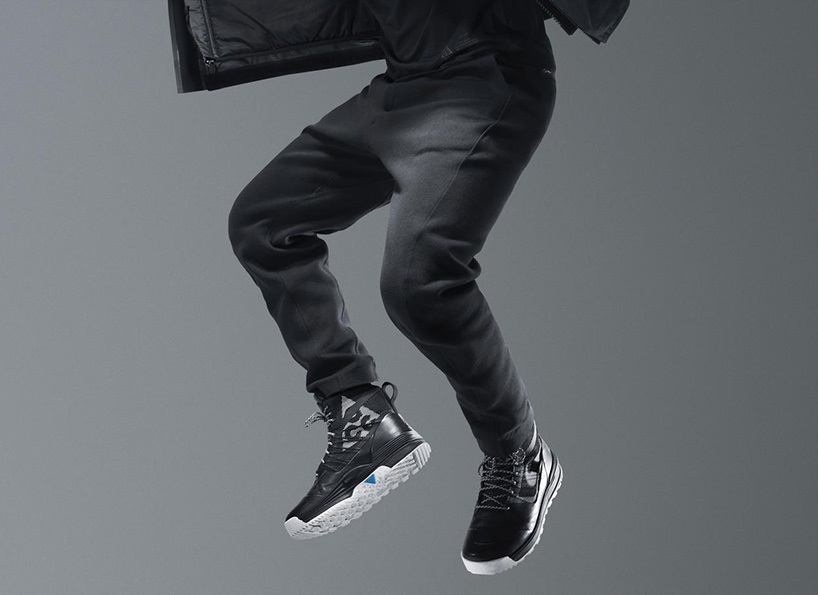
Gone were the loud nineties colors, replaced by black, three-layer GORE-TEX, taped seams, deployable hoods, and reflective logos. The launch included the Responder backpack, selling through select global NikeLab stores. Hugh framed it as an athlete’s challenge to build something no one else could, successfully shaping a new generation of techwear design.
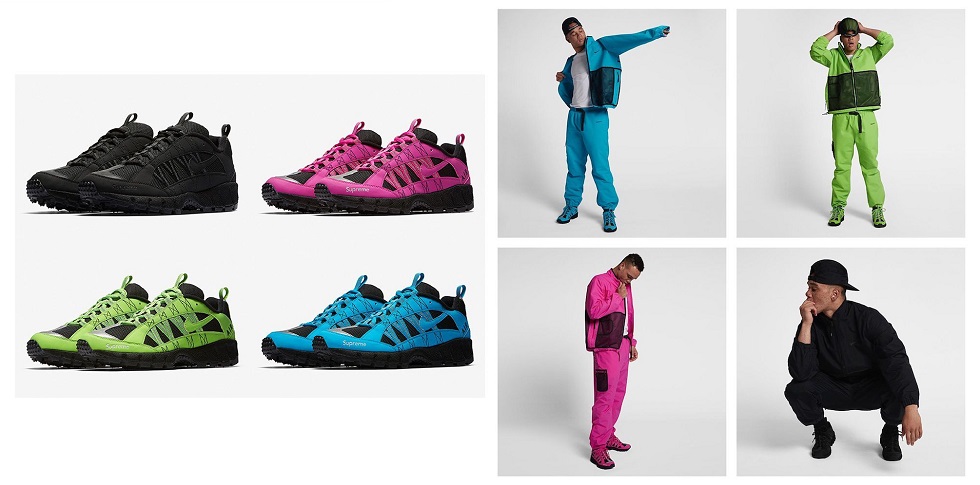
The partnership ended in 2018, with Nike steering ACG back toward a retro sportswear direction under senior creative director James Arizumi. Classics like the Air Mada, Torre Mid, Goadome, and Baltoro returned, alongside high-profile collaborations with Comme des Garçons and Supreme.
Undefended Ground
While ACG enjoyed cultural cachet, Nike made strategic missteps. In 2020, under CEO John Donahoe, Nike pulled back from major wholesale partners like Foot Locker and Dick’s Sporting Goods to focus heavily on direct-to-consumer digital sales. While direct sales initially climbed, innovation thinned, and the wholesale vacuum was swiftly filled by rising competitors like On and Hoka just as pandemic-driven running booms took off.
By the summer of 2024, Nike suffered a historic stock drop, leading to Donahoe’s departure and the return of 32-year Nike veteran Elliott Hill as CEO, with a mandate to restore core sports performance and wholesale relationships. Meanwhile, the trail running market had exploded, leaving Nike to realize that while it could easily manufacture a trail vest, it had to actively re-earn its right to matter on the trail.
Back Outside
On February 2, 2026, Nike officially reintroduced ACG as a dedicated outdoor-performance brand focused on trail running, hiking, and exploration, folding Nike Trail directly into the lineup under VP and general manager Scott LeClair.
The product rollout matched the ambition: the Ultrafly and Zegama trail shoes, the Lava Loft down jacket, the GOAT pack vest, and the Daymax pack. Later in the year at UTMB in Chamonix, they debuted the Picklejus, a big-mountain trail shoe featuring a new "GOATEK" outsole compound designed to reduce reliance on Vibram. Prototypes were meticulously tested by a growing All Conditions Racing Department, with athletes logging thousands of miles in unmarked shoes.
Nike also leaned heavily into experiential marketing. During the Milan Winter Olympics, they painted a heritage Italian train bright orange to run the "All Conditions Express" into the Orobic Alps, complete with a mountain-refuge café car and mobile gear labs, hosted by tennis star Jannik Sinner and Paralympic champion Bebe Vio. They sponsored the Broken Arrow Skyrace with a record $150,000 prize purse, partnered with China’s Chongli 168 Ultra Trail, opened an ACG Base Camp store in Beijing, and collaborated with Rivian on a custom R1T "Ultimate Aid Station" truck for remote ultramarathons.
The Trust Problem
Despite these grand gestures, the trail running community remains skeptical. Competitors like Norda and Salomon hold deep trust among ultra runners, and critics note that authentic trail adoption takes more than high-budget campaigns. Notably, the branding on recent gear leans heavily on "ACG" rather than "Nike ACG," reflecting a careful navigation of consumer perception.
Concurrently, the lifestyle side of ACG continues to thrive alongside performance, partnering with Cactus Plant Flea Market and Travis Scott on high-profile streetwear capsules. The tension between mountain utility and urban style remains central to the brand’s identity.
What ACG retains, however, is an unmatched origin story—born from a pair of ruined running shoes sent back in a postal box in 1978. Today, feedback comes from athletes testing handmade prototypes in Beaverton, but trust on the trail cannot be bought with trains or trucks. True to its origins, it must be earned the hard way: on foot, a long way out, and largely off-trail.