The year 2026 has proven to be an exceptionally challenging period for airlines worldwide, but carriers based in the vital Gulf region have shouldered a disproportionate share of the pressure. Ongoing conflicts, shifting security parameters, and escalating geopolitical tensions across the Middle East have forced many operators to rapidly adapt their flight schedules, suspend vulnerable routes, and significantly pare back operations.
Dubai-based low-cost carrier flydubai has not been immune to these regional headwinds. According to comprehensive data from aviation analytics provider Cirium, the airline’s overall network capacity is down by a striking 20% compared to the same period last year. To navigate these turbulent operational conditions, the carrier has been forced to reevaluate its route map, scaling back frequencies and eliminating several destinations entirely across multiple continents.
A comparative analysis of flydubai’s scheduled flights between January and October 2026 against its forward-looking schedule from November 2026 through September 2027 reveals the full extent of these network cuts. While some suspensions are temporary measures designed to weather short-term instability, other markets have been abandoned outright as the carrier pivots resources toward high-demand, resilient routes.
These Are The Destinations Flydubai Has Removed In 2026
Unsurprisingly, the most pronounced impact on flydubai’s network has fallen upon its Middle Eastern and immediate regional neighbors. All eight of the Dubai-based airline’s Iranian destinations have been heavily affected by recent network reductions.

The complete roster of affected Iranian cities includes Tehran (IKA), Mashhad (MHD), Bandar Abbas (BND), Lar (LRR), Shiraz (SYZ), Esfahan (IFN), Bushehr (BUZ), and Kerman (KER). Flydubai had maintained operations to all of these locations earlier in the year, but progressive security escalations and regional airspace considerations prompted the carrier to suspend services.
Flydubai originally established a foothold in the Iranian market back in 2014, when it inaugurated flights to Tehran and Mashhad. Over the ensuing years, the airline steadily expanded its footprint into a variety of secondary Iranian cities, cultivating strong and consistent passenger demand. During peak operational periods last year, flydubai scheduled more than 60 weekly departures across the country. Because of this historical commercial success, aviation industry analysts suggest that these routes could eventually return to the airline’s schedule if regional geopolitical conditions stabilize and security parameters improve.

Beyond Iran, the Kingdom of Saudi Arabia represents another major market significantly impacted by the airline’s strategic adjustments. Since the beginning of October, Saudi Arabia has experienced a series of security incidents targeting regional airports and critical infrastructure. In response to these developments, several prominent international carriers, including mainline sister carrier Emirates, Qatar Airways, and Etihad Airways, have temporarily suspended select services to the Kingdom.
Aligning with these broader industry precautions, flydubai has temporarily halted its flights to a collection of Saudi Arabian cities. The affected destinations in the Kingdom include Alula (ULH), Neom Bay (NUM), Hofuf (HOF), the Red Sea Project (RSI), Gizan (GIZ), Jouf (AJF), Qaisumah (AQI), Nejran (EAM), and Yanbu al Bahr (YNB). While some of these services are anticipated to return in the future, the dynamic nature of the security situation means there is currently no firm indication of when flights will resume.
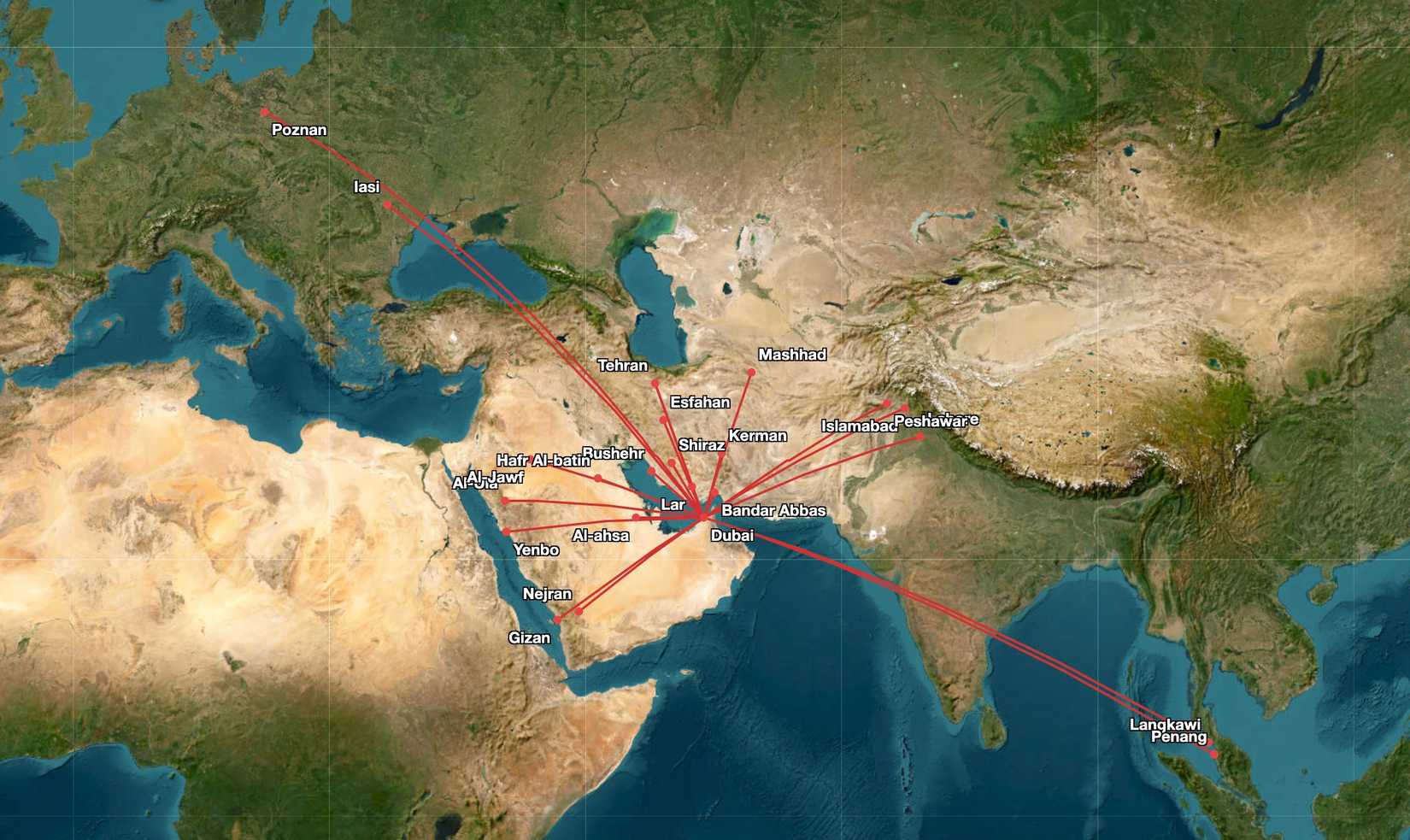
Flydubai’s network reductions have also touched parts of South Asia and Europe. In Pakistan, the carrier has trimmed frequencies or adjusted operations to key hubs such as Islamabad (ISB), Lahore (LHE), and Peshawar (PEW). Meanwhile, European expansion plans have faced temporary or localized setbacks, evidenced by the suspension of services to Poznan (POZ) in Poland and Iasi (IAS) in Romania.
Flydubai Exits Malaysia Just Two Years After Entering The Market
Perhaps one of the most notable and permanent network cuts involves Malaysia, a market from which the UAE low-cost carrier has withdrawn entirely. Flydubai originally entered the Southeast Asian nation in 2024, introducing year-round flights to the popular resort islands of Penang and Langkawi. At the time of their launch, these routes made flydubai the exclusive carrier offering direct connections from Dubai International Airport (DXB) to these two distinct Malaysian destinations.

To operate these long-haul leisure routes, the airline deployed its versatile Boeing 737 MAX 8 aircraft. The flight routing typically saw aircraft depart Dubai nonstop for Penang International Airport (PEN), before continuing onward to Langkawi International Airport (LGK) on the same aircraft rotation, with the return journey following the identical path.
Covering a distance of approximately 3,275 miles, the Dubai to Penang sector stood out as flydubai’s longest scheduled route. This operation aligned closely with the carrier’s broader corporate strategy of bridging Dubai with underserved secondary markets across its expanding network. However, commercial realities and shifting network priorities ultimately led to a change in direction; the UAE carrier operated its final flights on the Malaysian service in March 2026, and the routes have been completely absent from subsequent schedule releases.

With the complete withdrawal from Malaysia, flydubai’s presence in Southeast Asia is now concentrated entirely in Thailand. The airline continues to serve Krabi International Airport (KBV) and Bangkok’s Don Mueang International Airport (DMK) with strong commercial momentum. Passenger demand for the Bangkok service has proven particularly robust. Flydubai only inaugurated flights to the Thai capital in July 2026, initially offering a modest once-daily departure. Spurred by rapid and overwhelming passenger uptake, the airline doubled its frequency to twice daily within just a few weeks of launch, and further plans are in motion to elevate the route to three daily flights beginning in December.
Flydubai’s Suspension Of Tel Aviv Flights Continues
Another critical component of flydubai’s operational adjustments involves its prominent Mediterranean and Middle Eastern link to Israel. The aviation community vividly recalls the disturbing security incident involving flydubai flight FZ1073, during which one of the pilots allegedly attempted to hijack the aircraft. In the immediate aftermath of that alarming event, flydubai suspended all flights to and from Tel Aviv, completely pausing its operations to Israel.

Historically, flydubai maintained a robust schedule to Tel Aviv, frequently operating up to ten daily flights to accommodate heavy business and leisure traffic between the UAE and Israel. According to updated scheduling data provided by Cirium, the airline is officially slated to resume its Tel Aviv services on November 16, 2026. Nevertheless, industry observers remain cautious, as it remains entirely unclear whether these flights will restart as planned given the broader, fluid backdrop of Middle Eastern geopolitics.
It is worth noting that while numerous international carriers have suspended flights to Israel for extended periods due to escalating regional hostilities, flydubai previously stood out as one of the few foreign airlines that maintained consistent operations to and from the country throughout much of the ongoing conflict. As the airline approaches its scheduled mid-November resumption date, management will undoubtedly weigh commercial demand against the stringent safety and security requirements essential for restoring this vital corridor.