If you have recently consulted the European Union’s official “Check how long you can stay” online tool and were confronted with a message stating your stay is “NOT OK,” with zero days of authorization remaining, it is imperative that you do not immediately cancel your travel plans. Recent technical testing and a growing volume of reports from frustrated travellers indicate that the tool is currently returning inaccurate results, frequently flagging compliant itineraries as violations of the strict Schengen Area 90/180-day rule.
The issue has become a significant point of concern for non-EU nationals planning travel to the Schengen zone. Many readers have reached out to SchengenVisaInfo over the past several weeks, expressing confusion and alarm after the portal indicated they had exhausted their allowance, despite their own personal records showing they remained well within the legal limit. Upon running the tool independently, we confirmed that the system is failing to calculate remaining days with the required precision, often providing a blunt “NOT OK” status without offering any reasoning, a breakdown of counted entries, or guidance on how to rectify the discrepancy.
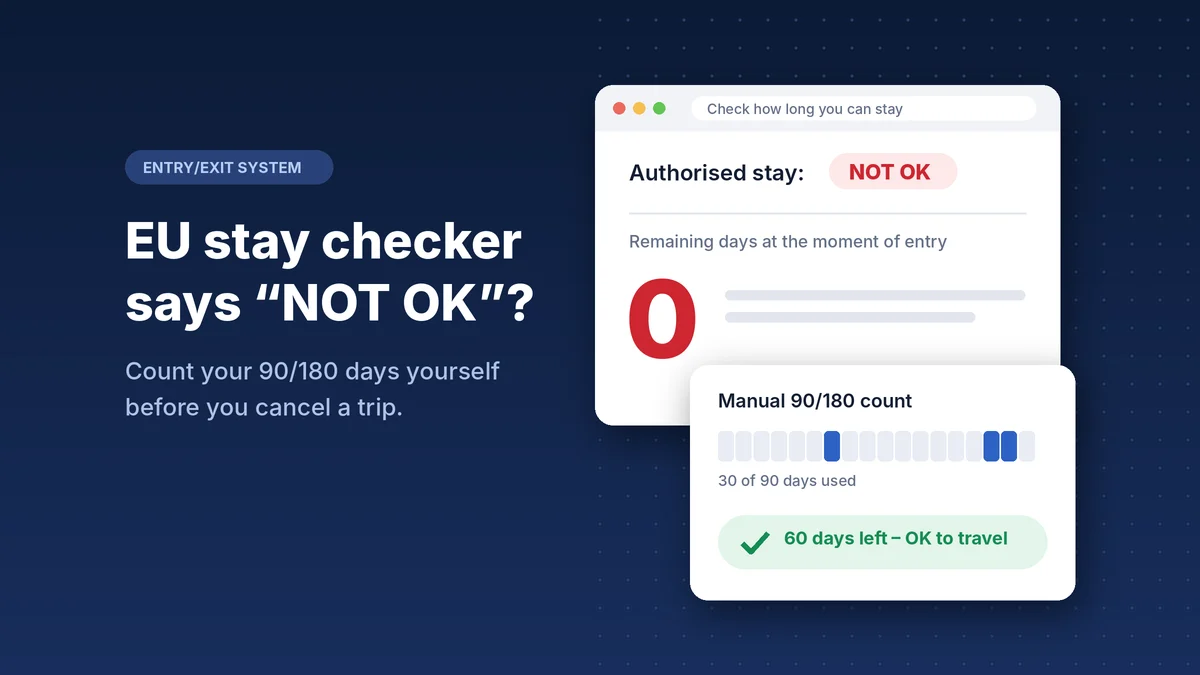
The error screen simply reads: “Authorised stay: NOT OK. The verification result and amount of remaining days of authorised stay were calculated on the basis of provided dates by the non-EU national and may vary depending on the actual date of entry and exit. Remaining days at the moment of entry: 0.” This lack of transparency leaves travellers in a state of uncertainty, as the tool provides no audit trail of which specific dates it considered, nor does it provide a mechanism for users to dispute the erroneous findings within the interface itself.
Understanding the Role of the Entry/Exit System
To understand why this tool is misfiring, it is necessary to examine the broader framework of the Entry/Exit System (EES). Fully operational across the Schengen Area since April 10, 2026, the EES was designed to modernize border security by replacing the traditional, manual stamping of passports for non-EU short-stay visitors with a comprehensive digital database. The stated purpose of the online checker was to offer travellers a reliable way to verify their compliance with the 90/180-day rule before arriving at the border.
The system is intended to function by pulling data directly from the traveler’s EES record. By entering a passport number, the issuing country, the intended destination within the Schengen Area, and optional entry and exit dates, the system is supposed to perform the necessary mathematical calculations to confirm if a trip is permissible. However, the integrity of the tool’s output is fundamentally dependent on the quality and completeness of the historical data stored in the EES. If the underlying data is flawed, incomplete, or missing entirely, the resulting calculation is inherently unreliable.
Why the EES Checker Frequently Miscalculates Days
While we have reached out to the European Commission for clarification regarding these persistent technical errors, no response had been provided at the time of publication. In the absence of an official explanation, several systemic gaps have emerged that likely explain why the tool is failing to produce accurate results for many travellers.
A primary factor is the system’s handling of travel that occurred prior to the April 10, 2026, launch date. The EES is not retroactive in its digital tracking. Consequently, individuals who were present in the Schengen Area before the system went live may find that their historical records are incomplete. Agencies such as Sweden’s Migration Agency have explicitly advised that individuals registered in the EES prior to the launch date should not rely solely on the online tool, recommending instead that they maintain a manual count based on their physical passport stamps. Consumer advocacy groups, including Which?, have echoed this warning, noting that the tool often fails to account for Schengen visits that took place before the digital transition.

Furthermore, the implementation of the EES was not entirely seamless. Following the April rollout, the EU permitted member states to implement a temporary 90-day suspension of the system—with the option of a 60-day extension—to mitigate potential bottlenecks at borders during the high-traffic summer season. During these periods, some border authorities reverted to manual passport stamping. This creates a fragmented digital record; if a traveler entered the zone during a period where a country was relying on manual stamps rather than the EES, that specific entry or exit may never have been uploaded to the central database. The system, seeing an entry but missing the corresponding exit, may incorrectly assume the traveller is still inside the Schengen Area, thereby depleting their 90-day allowance.
Additionally, the tool’s own disclaimer acknowledges that the result is heavily reliant on the accuracy of the dates manually entered by the user. Because the system is sensitive to these inputs, a single incorrect date or a missing entry in the form can lead to a significant discrepancy in the final result.
How to Manage Travel Plans Amidst Technical Uncertainty
It is crucial for travellers to understand that an “NOT OK” result on the EU’s website does not constitute a formal denial of entry, nor does an “OK” result act as a binding guarantee. Ultimately, the authority to grant or deny entry rests solely with the border guard at the point of arrival, who relies on a combination of digital records, passport stamps, and the traveller’s ability to prove their itinerary.
If you encounter an error, the most effective course of action is to perform a manual audit of your travel history for the preceding 180 days. By gathering boarding passes, booking confirmations, and physical passport stamps, you can reconstruct your actual time spent in the Schengen Area. We recommend using an independent, manual calculator where you can input each entry and exit date yourself. Since these calculators do not rely on the potentially corrupted data held in the EES, they often provide a more accurate representation of your remaining allowance.
Consider a practical example: a British traveller spends 10 days in Spain from July 1 to July 10, 2026. They subsequently plan a trip to Italy from November 2 to November 21, 2026, for an additional 20 days. When calculating the 180-day window from the final date of November 21, the July trip is included. This accounts for a total of 30 days used, leaving the traveler with 60 days of their 90-day allowance remaining. If the EU tool returns a “NOT OK” status for this itinerary, it is almost certainly due to a technical error, such as a missing exit record from the July trip. In such a scenario, rather than abandoning travel plans, the traveler should bring all documentary evidence of their actual movements to the border to present to the officer on duty.
Correcting Your EES Record
If you discover that your EES record is indeed incorrect, you have the right to request a review and correction of your data. The process involves identifying the data controller for the Schengen country you last visited—a list of which is available through the EU’s official data protection contacts page—and submitting a formal request via email. You should include all available evidence, such as copies of flight tickets, accommodation receipts, and relevant passport pages. It is important to temper expectations regarding response times; the bureaucratic nature of these requests means they are rarely processed quickly.
For those with upcoming travel, the most pragmatic approach is to carry comprehensive physical documentation in your hand luggage. Having proof of your entry and exit dates readily available allows you to provide immediate clarification to a border guard should the digital system flag you incorrectly. While the transition to the EES is intended to streamline the border experience, the current technical challenges underscore the importance of maintaining your own detailed personal travel records until the system matures and the accuracy of its reporting improves.