For travelers seeking a profound connection to the past, a regular dose of travel dreaming often serves as a remedy for the soul. Among Europe’s countless historic destinations, few capture the imagination quite like Siena, Italy. Featured prominently in travel writer Rick Steves’ collection For the Love of Europe—which compiles 100 of his favorite places, people, and stories from a lifetime of exploring the continent—this Tuscan gem offers what is arguably Italy’s most authentic and well-preserved medieval experience.
Stretched gracefully across a rolling Tuscan hill, Siena presents an architectural landscape where the present seamlessly mirrors the past. Courtyards feature flower-decked wells, historic churches quietly display centuries-old art, and winding alleys dead-end into sweeping panoramas of red-tiled rooftops. This is a city built fundamentally for strolling. With its stony skyline and rustic brick lanes tumbling in every direction, the town functions as an architectural time warp, a place where pedestrians rule the streets and modern life takes a respectful backseat to history.
Today, the self-assured Sienese remember their centuries-old accomplishments with immense civic pride. During the 14th century, Siena stood as one of Europe’s largest and most influential urban centers. It was a major military force that operated in the same elite tier as Florence, Venice, and Genoa. However, history took a dramatic turn when the city was weakened by a disastrous plague and subsequently conquered by its fierce rivals from Florence. Following defeat, Siena faded into a regional backwater—a status it has maintained ever since. Paradoxically, Siena’s political and economic decline became the modern traveler’s ultimate gain, as its prolonged stagnation effectively froze and preserved its magnificent Gothic identity for future generations.
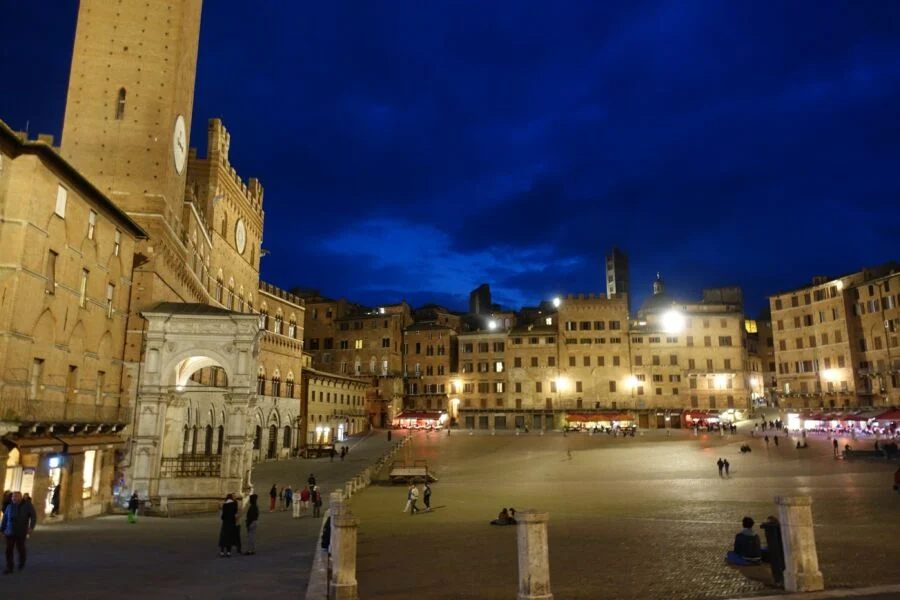
This architectural and cultural preservation is most notable in Il Campo, the dramatic focal point where many visitors begin their exploration of the city. Shaped like a giant shell, this great central piazza features a sloped, red-brick floor that fans gracefully outward from the towering City Hall. Designed intentionally for people rather than vehicles, the square offers a perfect invitation to loiter, absorb the atmosphere, and watch daily life unfold. Il Campo immerses visitors in a vibrant urban theater where troubadours strum guitars, lovers whisper and stroke one another’s hair, and weary travelers rest comfortably against the stone. For many seasoned explorers, it easily earns the title of the finest piazza in all of Europe.
While most Italian cities traditionally gather their citizens around a cathedral located on the main square, Il Campo takes a distinctly civic approach. Instead of a church, the piazza gathers the Sienese citizenry around its City Hall, anchored by a skyscraping municipal tower. Climbing to the dizzying top of the 100-yard-tall bell tower requires physical endurance, but the reward is a breathtaking panoramic survey of the surrounding cityscape and countryside. Standing atop the campanile also evokes a deep historical realization about the city’s unique worldview: in medieval Siena, kings and popes took a distinct back seat to the ordinary people. The entire layout and its monuments were statements dedicated to secular government, civic society, and early humanism.
The public is warmly welcomed inside the interior of the City Hall, where for seven centuries, instructive frescoes have served as visual reminders of the profound effects of good and bad government. One remarkably preserved fresco depicts a utopian republic existing blissfully at peace under wise leadership, while a contrasting fresco vividly depicts a city in ruins, overrun by the corrosive forces of greed and tyranny.
Yet, despite its strong civic and secular foundations, the Church still holds a deeply revered place in Siena. If Il Campo represents the beating heart of the city, the magnificent Duomo serves as its spiritual soul. Located just a few blocks off the main square and sitting proudly atop Siena’s highest point, this striking white- and dark-green-striped cathedral is visible for miles across the Tuscan landscape. As ornate as Gothic architecture gets, the cathedral is lavished inside and out with intricate statues, fine details, and stunning mosaics. Adding a striking personal touch to the interior, the stony heads of nearly 2,000 years of popes—totaling over 170 pontiffs so far—form a continuous ring high along the interior walls, peering down silently upon all who enter.
The interior of the church is further enriched by masterpieces of great art, including significant statues carved by renowned masters such as Michelangelo and Bernini. In 1268, Nicola Pisano carved the cathedral’s exquisite marble pulpit, a structural and artistic marvel crowded with delicate Gothic storytelling. Visitors who get up close can study the meticulously carved scenes depicting the life of Christ and the solemn imagery of the Last Judgment.
For those looking to escape the daytime crowds gathered in the cathedral and around the main square, venturing away from the immediate city center reveals a quieter, equally fascinating side of Siena. Wandering intentionally down the intriguing back streets reveals thoroughfares studded with historic iron rings once used for tethering horses, now lined with colorful flags snapping gently in the breeze. These vibrant flags represent the city’s historic contrade, or distinct neighborhoods. The fierce loyalties of these neighborhoods burst into vivid, competitive display twice each summer during the Palio, a wild, bareback horse race that temporarily transforms Il Campo into a thrilling, tightly packed racetrack.
Wandering further into the far reaches of the city, travelers are inevitably tempted by local culinary specialties displayed in neighborhood shops along the way. Artisanal offerings include gourmet pasta, vintage Chianti wines, savory boar prosciutto, and the city’s undisputed culinary crown jewel: panforte.
Panforte stands as Siena’s ultimate claim to caloric fame. This rich, chewy concoction blends nuts, honey, and candied fruits into a dense specialty that routinely impresses even dedicated fruitcake haters. Local bakeries proudly claim that their specific recipes date all the way back to the 13th century. The competition and secrecy are so fierce that some establishments even require their baking employees to sign strict nondisclosure agreements to ensure they never reveal the exact, proprietary spice blend used to flavor their version of this beloved and heavy traditional cake.
Ultimately, a key to truly enjoying Siena is the ability to mentally imagine the city thriving in its 14th-century heyday while simultaneously taking advantage of today’s modern comforts and social traditions. After sampling a rich chunk of local panforte, visitors often choose to linger into the evening hours, long after the daytime tour groups have boarded their buses and departed the city limits. Ducking into a local bar for an aperitivo, or happy hour, which frequently includes a complimentary buffet spread, primes travelers for the traditional passeggiata—the classic Italian evening stroll. Timing an arrival back at Il Campo just right allows visitors to savor that magical twilight moment when the evening sky forms a rich blue dome, held aloft by the proud, historic towers of Siena.