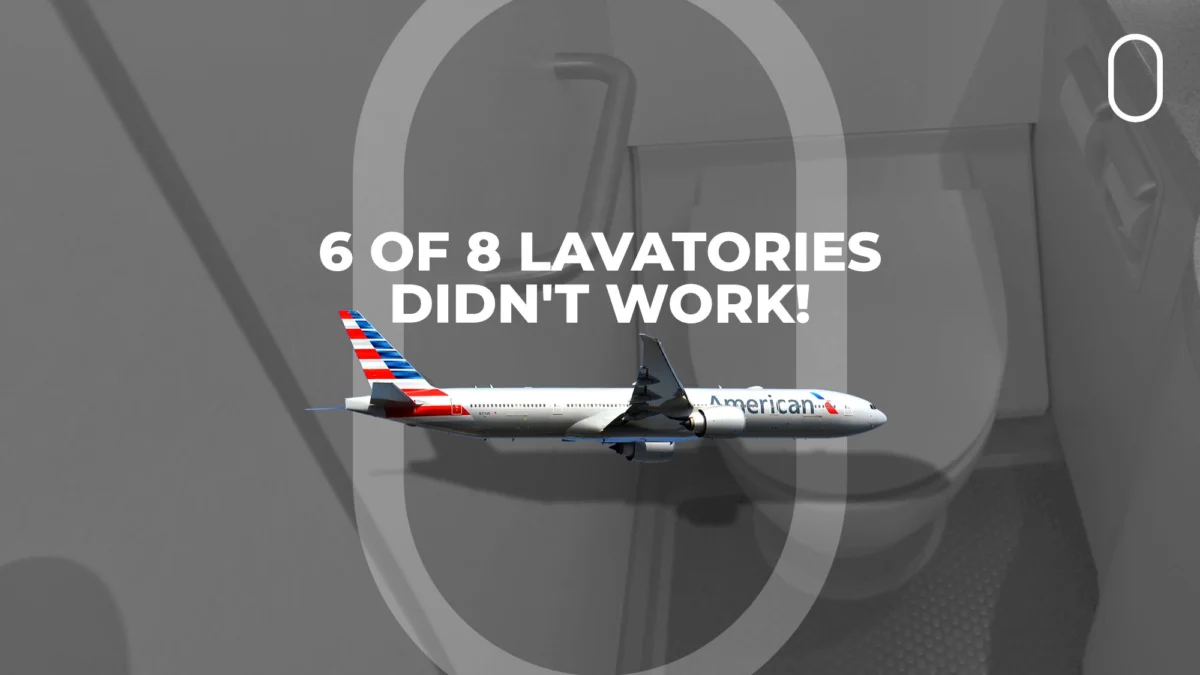
An American Airlines transatlantic flight from Madrid to Dallas was forced to make an unexpected diversion to New York in early October after a severe maintenance issue crippled the vast majority of the aircraft’s onboard restroom facilities, leaving hundreds of passengers and crew members to share just two working lavatories for an ocean-crossing journey.
The incident, which unfolded aboard a widebody Boeing 777 aircraft, highlights the intricate operational challenges and passenger comfort thresholds that long-haul commercial airlines face when critical cabin infrastructure fails mid-flight. Operating as American Airlines Flight AA37, the scheduled service was bound for Dallas/Fort Worth International Airport (DFW) from Adolfo Suárez Madrid–Barajas Airport (MAD) when the situation onboard deteriorated to the point where the flight deck crew had to prioritize passenger needs and operational safety by altering their flight path.
According to operational data and flight details, the widebody aircraft was carrying a substantial passenger and crew complement, with a total of 287 people on board. As the flight progressed across the Atlantic Ocean, a mechanical failure rendered six of the aircraft’s eight onboard lavatories completely inoperable. For a modern long-haul airliner carrying nearly 300 occupants on a flight lasting roughly eight to ten hours, access to adequate sanitation facilities is a fundamental requirement for basic human comfort and hygiene. With three-quarters of the facilities out of service, the remaining two functioning lavatories quickly became a severe bottleneck, creating unsustainable conditions inside the cabin for a journey of that duration.
Faced with the rapidly compounding problem and the growing discomfort of the passengers on board, the flight crew made the operational decision to interrupt the transatlantic journey rather than attempt to complete the remaining hours of the flight to Texas. The pilots elected to divert the aircraft toward the northeastern coast of the United States, targeting New York’s John F. Kennedy International Airport (JFK) as a suitable and well-equipped diversion point where American Airlines maintains a significant operational presence and maintenance base.
As the aircraft approached the New York metropolitan area, the flight crew declared a pan-pan. In aviation terminology, a pan-pan is an internationally recognized urgency signal used to announce an onboard situation that is serious and requires timely assistance, though it does not constitute an immediate life-threatening emergency such as a mayday call. The urgency designation ensures that air traffic controllers are aware of the non-standard situation and can provide priority handling and routing through busy airspace, facilitating a smoother and more expedited descent and landing.
American Airlines Flight AA37 successfully navigated its approach and landed safely at John F. Kennedy International Airport shortly after midday local time. Emergency services and ground operations teams were standing by as a standard precaution following the urgency declaration, though the landing itself was uneventful and the aircraft touched down without further incident.
Following the touchdown, the aircraft taxied to a gate where airport operations and airline personnel could assist the displaced passengers. The unexpected diversion naturally caused significant delays for the travelers booked on the Madrid-to-Dallas itinerary, requiring American Airlines to coordinate alternative travel arrangements, rebooking options, and on-ground support for the 287 passengers whose journey was abruptly interrupted over the northeastern United States. Ground teams at JFK worked to manage the logistics of processing a widebody aircraft full of international travelers who were unexpectedly stranded mid-journey due to a sanitation infrastructure failure.
The mechanical failure involving the aircraft’s waste and vacuum systems underscores the complex mechanical ecosystem required to support hundreds of passengers on modern long-haul routes. Boeing 777 aircraft, which form a major backbone of long-haul international fleets for carriers like American Airlines, are equipped with sophisticated vacuum waste systems designed to manage high volumes of usage over extended periods. However, when multiple valves, controllers, or system lines experience failures, entire banks of lavatories can go offline simultaneously.
While aircraft are routinely dispatched with fully operational cabin systems, unexpected mid-flight component failures can occur. Airlines maintain strict maintenance protocols, but when a cascade of restroom failures happens over the middle of the ocean, the options available to flight crews are severely limited. Turning back or diverting to the nearest major hub often becomes the only viable solution to restore basic standards of passenger care, particularly on flights spanning many hours where the remaining facilities cannot reasonably cope with passenger demand.
The diversion of Flight AA37 serves as a notable reminder of how seemingly mundane logistical and mechanical issues can directly impact major international flight operations, requiring coordinated efforts between flight deck crews, air traffic control, and ground station personnel to resolve safely and efficiently.