For many travelers and art historians alike, one of the profound joys of exploring cultural heritage is experiencing in-person encounters with great works of art. These masterpieces, often collected and cataloged in explorations of Europe’s top artistic achievements, tell the sweeping stories of human history, faith, and resilience. Among the most remarkable of these artifacts is a sacred manuscript that survived the literal and figurative darkness of early medieval Europe: the Book of Kells.
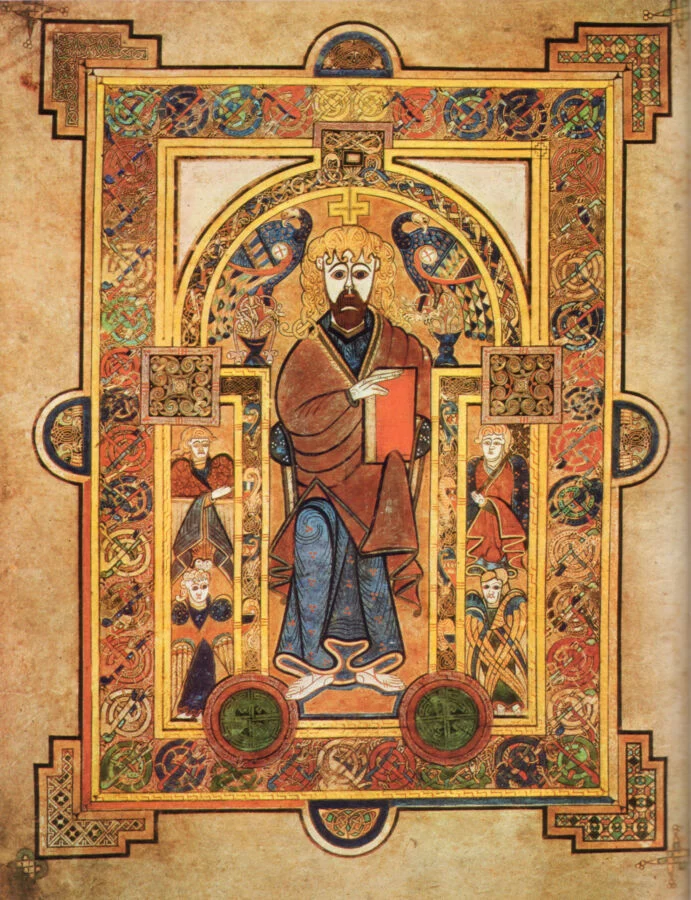
At the center of one of its most famous pages, a majestic figure of Jesus Christ sits upon a throne, solemnly cradling the holy word of God in the form of a sacred book. Portrayed with a lush head of curly flaxen hair and a thoughtful, serene expression, this heavenly depiction of Christ is seated beneath a decorative archway, enveloped in a labyrinth of colorful, intricately woven designs.
This stunning illustration, widely known as "Christ Enthroned," serves as a visual gateway within an ancient gospel text. It is strategically positioned right at the crucial narrative turning point in the Gospel of Matthew—specifically at Matthew 1:18—where the divine Jesus is introduced on the brink of being born as a humble mortal on Earth.
This intricate artwork is just a single page of the legendary, 1,200-year-old gospels recognized globally as the Book of Kells. Widely considered to be the finest and most breathtaking piece of visual art surviving from the so-called Dark Ages, this manuscript stands as a remarkably rare artifact from a deeply troubled and precarious era of human history.
To understand the true magnitude of the Book of Kells, one must look back to the year 800. The mighty Roman Empire had long since crumbled, leaving the European continent fractured, volatile, and shrouded in chaos. Savage Viking raids involving widespread pillaging and violence plagued coastal and river settlements. Meanwhile, the Christian faith, which had been officially embraced and institutionalized during the final decades of the Roman Empire, was rapidly faltering. Across vast swaths of Europe, society was reverting to pagan traditions and widespread illiteracy.
Yet, amid this profound turmoil, on the remote and rugged fringes of the European world, a dedicated band of scholarly Irish monks fought to tend the fading embers of civilization.
These devoted monastics toiled tirelessly in remote scriptoriums to preserve the sacred word of God within the pages of what would become the Book of Kells. The physical undertaking alone was staggering. The monks slaughtered 185 calves, carefully curing and drying their hides to produce 680 smooth, cream-colored pages of vellum. Once the material was prepared, tonsured monks picked up their delicate swan-quill pens and went to work.
With extraordinary precision, they meticulously penned the biblical text in Latin, ornamenting initial letters with elaborate curlicues and interspersing the written passages with full-page, vibrant illustrations. This monumental labor of love resulted in what is known as an illuminated manuscript. However, the creation process was fraught with danger. In the year 806, the project was violently interrupted when Viking raiders savagely pillaged the remote Irish monastery, slaughtering 68 monks in the process. Miraculously, the surviving members of the brotherhood managed to flee, carrying their precious, unfinished work to the Abbey of Kells, located near Dublin, where they ultimately completed the sacred volume.
Today, "Christ Enthroned" represents just a single page—precisely one-680th—of this wondrous historical book. Upon closer inspection by scholars and visitors, the page’s incredible detail-work springs to life with startling complexity. Flanking Christ on either side are two mysterious men holding traditional robes, alongside two grotesque-looking angels with their wings folded reverently in front of them. Framing Christ’s head are majestic peacocks, traditional Christian symbols representing the resurrection, with their feet intricately tangled in vines, symbolizing his earthly Israelite roots.
Artistically, the depiction of Christ is far from realistic. He poses with a stiff, formal rigidity reminiscent of a traditional Byzantine icon, featuring almond-shaped eyes, unusually placed ears, and elongated fingers.
Instead, the true artistic triumph of the page lies in its intricate, mesmerizing designs. The margins and borders form a veritable jungle of geometric spirals, flowing swirls, and intertwined snakes—complete with tiny snake heads peeking out from the complex patterns. In creating these pages, the Irish monks masterfully blended traditional Christian symbols, such as the cross, the peacock, and the vine, with the pagan Celtic motifs of the surrounding world, including circles, spirals, and interwoven ribbon patterns.
Every element is rendered in vivid, enduring colors—including striking shades of blue, purple, red, green, yellow, and deep black—all meticulously etched by hand using a swan-quill pen. The dedication to ornamentation is so absolute that out of the book’s total 680 pages, only two contain no decorative elements whatsoever.
As Christianity gradually regained its institutional footing and stability across Europe in the centuries that followed, monasteries everywhere began producing their own illuminated manuscripts, though very few ever achieved the supreme opulence and artistic complexity of the Book of Kells. The era of hand-copied texts finally drew to a close in 1455, when Johann Gutenberg invented the movable-type printing press. As books transitioned into mass-produced items, thousands of anonymous monks were permanently freed from their arduous roles as the primary scribes and preservers of human civilization.